Jean Mouton
Jean Mouton's early sixteenth-century motets and masses unfold in supple, equal-voiced polyphony, often built on canons. The writing keeps every line singing, with continuous melodic flow rather than sharp textural contrast.
More than a hundred motets survive beside masses, Magnificat settings and chansons, many written for court and church occasions. Canonic craft sits at the centre of the sound: voices enter on the same material at staggered times, sometimes as double or quadruple canons that still read as graceful, fully scored polyphony. Nesciens mater, an eight-part Christmas motet grown from four canonic lines, is a clear instance of that ingenuity. Beside Josquin the textures can feel more even and less sharply varied, yet the imitation stays close and the melodic thread keeps moving. Later composers returned to his joyful Christmas pieces as models for masses of their own.
Compositions by Jean Mouton appear on
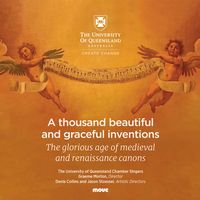
A Thousand Beautiful and Graceful Inventions
Subtitled ‘The glorious age of medieval and renaissance canons’, this programme of late Middle Ages and Early Modern choral music is sung by the University of Queensland Chamber Singers under Graeme Morton. The illustrated booklet has programme notes by Denis Collins and Jason Stoessel, with complete texts.