Listen & tracks
5 works · 65:06
-
Three DancesKen Herrera 3 movements6:18
- 1 i. Andantino 2:10
- 2 ii. Allegro moderato 1:56
- 3 iii. Allegro vivo 2:12
-
4 Second Nocturne Ken Herrera 7:20
-
5 Flamenco Sketches Ken Herrera 14:29
-
Aurora BorealisKen Herrera 3 movements9:07
- 6 i. Allegro commodo 2:30
- 7 ii. Adagio non troppo 3:04
- 8 iii. Maestoso 3:33
-
Second Piano SonataKen Herrera 4 movements27:52
- 9 i. Andante – Allegro commodo – Allegro vivo 12:36
- 10 ii. Allegro molto 5:02
- 11 iii. Adagio molto – Moderato 6:44
- 12 iv. Adagio – Allegro non troppo 3:30
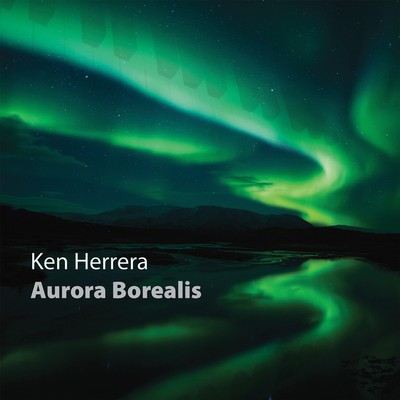
Ken Herrera’s second disc of solo piano works, Aurora Borealis, continues his odyssey into other worlds of sound. The shimmering luminescence of the title suite melds with the cheerful simplicity of the Three Dances. Poignant harmonies in the Second Nocturne give way to the exotic rhythms and Andalusian verve of Flamenco Sketches. Crowning the programme, his second piano sonata is a bold, ambitious work brimming with fire and pathos.
Recorded at Move Records studio in January 2015, the music ranges from learner-friendly dances with Brazilian and folk sway, through a skeletal nocturne and impressionistic flamenco sketches, to a four-movement sonata coloured by Mediterranean and North African influences.
In the artist’s words
Three Dances (2011)
One of the main strands of my composing has always been easier music for learners. In these dances the left hand work is fairly simple and easy to master, allowing the player to concentrate on other elements. The first piece has a gentle Brazilian sway to it, while the second owes more to North American folk music. The third? I’m not quite sure where this one came from, but there’s definitely some Spanish touches in there, as well as something that sounds more like Shostakovich, and who knows what else...
Second Nocturne (2010)
Without transgressing the outer limits of twilight and dawn, this piece tries to get as far away from more traditional ‘night music’ as possible. Instead of rippling arpeggios undulating under a soulful melody, the opening is bare and unsettling. This night is a skeletal one, and although there are flashes of consolation and pleasure throughout, it is the bleak and macabre chorale of the opening returning again and again which defines the nocturne.
Flamenco Sketches (2012)
Despite being completely unable to dance it, flamenco has long been a passion of mine. This rhapsodic piece is a slightly blurred, impressionistic view of a music and dance that is generally bold and sharply defined; hence the ‘sketches’ of the title. Episodes come and go very quickly in the music, seemingly very different but actually based on a small amount of musical material. You might hear the flicker of flames, the strumming of guitars and the thunder of feet and hands in ferocious syncopation.
Aurora Borealis (2011)
Looking through some photos of the Aurora Borealis, I was struck by the enormous variety of moods they suggested. That was the origin of this suite, three short ‘character’ pieces played without a break. The first is a glittering piece, full of filigree, kaleidoscopic colours and almost constant motion. The colours are more muted in the second, but occasional shafts of light do glimmer in the darkness. Finally another piece in perpetual motion, but whereas the first is mercurial and dazzling, this finale is majestic and not to be rushed.
Second Piano Sonata (2009)
Like my first sonata, the second takes inspiration from the musical cultures surrounding the Mediterranean, in particular those of North Africa and Spain. These influences are combined in a structure that basically follows classical forms, but in a way that is more intuitive than rigorous. More than any other piece that I have written thus far, this sonata traces a clear line between the very first note and the very last.
Reviews
As the title and the cover suggests the focus of this disc are the ever amazing Northern lights. I decided to play some of this music whilst watching some YouTube videos of the Northern Lights on my big screen TV. The effect was quite mesmerising funnily enough, it seemed to work best with the Second Nocturne which is sparse, elegiac work but whose mood fits the title and provide a perfect back drop to viewing the dancing lights of the north. The actual Aurora Borealis work itself is a short three movement foray where the final movement itself, marked maestoso, is indeed majestic yet light in colour and gives the impression of the varying levels of light as they may be viewed with the naked eye. Herrera's use of musical induction is evident throughout the second piano sonata. He assumes an individuality of sound combined with a variety of compositional techniques including some counterpoint in the first movement. The second and third movements offer a proof of his original premise that sound is not formed from just notes on a page but rather a translucence of reflective shimmering that, in this album, is portrayed by those mixtures of green, yellow and red lights flooding the night skies. It is evident that Herrera is a talented composer with an excellent knowledge of the piano and the skill to write effectively for it. The most interesting disc by an Australian composer in quite some time. ★★★★
Artists

Ken Herrera
piano
Ken Herrera is an Australian pianist and composer. His solo piano music embraces melody and a wide span of colour, from flamenco and tango to French impressionism and Middle Eastern inflection.
Digital booklet
Digital booklet Notes, texts and credits — read online or download the PDF Download the PDFPerformers
- Ken Herrera · piano
Technical credits
-
Recording Engineer
Vaughan McAlley
-
Mastering Engineer
Martin Wright
Details
- List price
- $25.00 AUD
- Total playing time
- 65 minutes 6 seconds
- Release date
- May 2015
- Categories
- Australian, Classical
- Musical work copyright
- © 2015 Ken Herrera
- Sound recording copyright
- ℗ 2015 Move Records
- Catalogue
- MCD 518
- EAN
- 9314574051827
More to explore
Tango Fantasy
An alluring Latin American odyssey: Ken Herrera’s solo piano programme of original tangos, a Baroque-tinged suite and a sultry nocturne that lean into waltz, milonga, bossa nova and blues.
Tales from the Dead Sea
Melbourne composer and pianist Ken Herrera's music draws together an extraordinary range of influences, from savage flamenco to delicate French impressionism, and from Middle Eastern and North African improvisation to the impassioned playing of John Coltrane and McCoy Tyner.