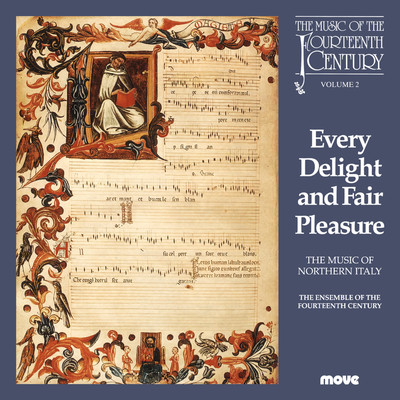
Listen & tracks
1 of 19 tracks have a preview · 19 works · 72:30
-
1 Cum altre uccele Anonymous 3:57
-
2 Per tropo fede Anonymous 4:02
-
3 Or qua compagni Anonymous 3:21
-
4 Lavandose le mane Anonymous 2:45
-
5 Chiamando un'astorella Anonymous 2:14
-
6 Nel mio bel orto Anonymous 2:57
-
7 All'ombra d'un perlaro Maestro Piero 3:02
-
8 Ogni diletto Maestro Piero 3:08
-
9 Quando l'aire comenza Maestro Piero 4:36
-
10 Sì come al canto della bella Iguana Maestro Piero 2:53
-
11 Con bracchi assai Maestro Piero 3:03
-
12 Cavalcando con un giovine acorto Maestro Piero 3:24
-
13 La douce cere Bartolino da Padova 3:12
-
14 Serva ziascuno Bartolino da Padova 2:36
-
15 Le aurate chiome Bartolino da Padova 2:12
-
16 Alba columba Bartolino da Padova 5:14
-
17 Imperial sedendo Bartolino da Padova 5:12
-
18 Sempre dona t'amai Bartolino da Padova 7:09
-
19 Non corer troppo Bartolino da Padova 7:33
The Music of the 14th Century, Vol. 2.
The programme draws on the Rossi Manuscript, the earliest substantial collection of trecento song, then turns to madrigals by Maestro Piero and later madrigals and ballatas by Bartolino da Padova. Liner notes cover the composers, the works, their historical setting, compositional technique, full translations and a stylistic reading of each piece.
It sits beside the Giovanni da Firenze and Jacopo da Bologna selection on Two Gentlemen of Verona.
Reviews
the occasional track can do wonders to relieve sensory biliousness if you're indulging in an unrelieved diet of orchestral and/or operatic music: epicurean excess for the ear.
Artists

Ensemble of the Fourteenth Century
ensemble
The Ensemble of the Fourteenth Century is a collective of specialist singers and instrumentalists brought together for the Fourteenth Century Recording Project. The ensemble was initially formed around the leading Australian mediaeval ensemble La Romanesca, which was expanded to provide the varied instrumental and vocal combinations required by the repertoire.
Maestro Piero
composer
Bartolino da Padova
composer
Digital booklet
Digital booklet Notes, texts and credits — read online or download the PDF Download the PDFPerformers
- Ensemble of the Fourteenth Century · ensemble
- John Griffiths · director
- John Stinson · director
Technical credits
-
Producer
John Griffiths
Martin Wright
-
Recording Engineer
Martin Wright
-
Venue
Trinity College Chapel
-
Thanks to
Australian Research Council
Creative Australia
La Trobe University
University of Melbourne
Details
- List price
- $25.00 AUD
- Total playing time
- 72 minutes 30 seconds
- Release date
- 1991
- Categories
- Early music, Vocal
- Genres
- Early Music, Vocal & Opera
- Musical work copyright
- © 1991 The University of Melbourne, La Trobe University
- Sound recording copyright
- ℗ 1991 Move Records
- Catalogue
- MD 3092
- EAN
- 9314574309225
More to explore
Two Gentlemen of Verona - The Music of the 14th Century Vol. 1
Two Gentlemen of Verona gathers secular polyphony from the first known generation of Italian composers. This volume presents madrigals, caccie and a motet by Jacopo da Bologna and Giovanni da Firenze.
I am Music - The Music of the 14th Century Vol. 3
The Music of the Fourteenth Century series presents some of the earliest and most significant polyphonic settings of late medieval lyric poetry. Songs by Francesco Landini, performed by the Ensemble of the Fourteenth Century.
A Florentine Annunciation - The Music of the 14th Century Vol. 4
The Music of the Fourteenth Century series presents some of the earliest and most significant polyphonic settings of late-medieval lyric poetry. This volume offers music for the Feast of the Annunciation, performed by Les Six.
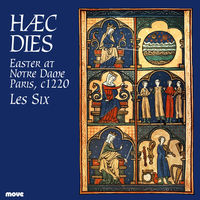
Hæc Dies
Easter at Notre Dame, Paris, c.1220. Music for Easter Sunday Mass as it may have been heard at Notre Dame early in the thirteenth century: chant propers, a complete ordinary cycle in two-part Leoninus-style settings, and three-part organum in the style of Perotin.
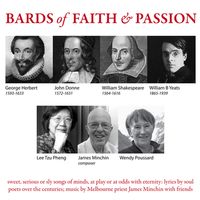
Bards of Faith and Passion
Jim Minchin sets poems by writers at play or at odds with eternity: soul-poet lyrics across the centuries, from anonymous Latin verse and the metaphysicals to Yeats, Shakespeare and living voices.
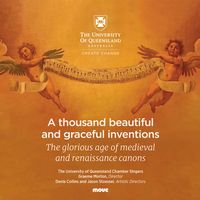
A Thousand Beautiful and Graceful Inventions
Subtitled ‘The glorious age of medieval and renaissance canons’, this programme of late Middle Ages and Early Modern choral music is sung by the University of Queensland Chamber Singers under Graeme Morton. The illustrated booklet has programme notes by Denis Collins and Jason Stoessel, with complete texts.