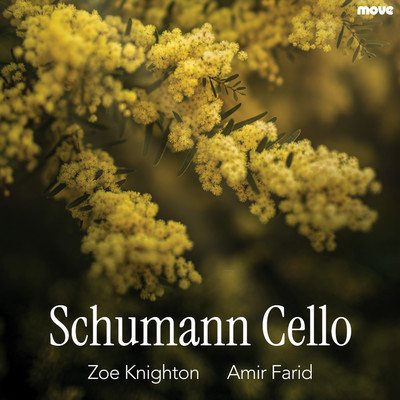
Listen & tracks
5 works · 66:14
-
6 Lieder, Op. 13Clara Schumann 6 movements13:53
- 1 Ich stand in dunklen Träumen 2:25
- 2 Sie liebten sich beide 1:58
- 3 Liebeszauber 2:28
- 4 Der Mond kommt still gegangen 1:48
- 5 Ich hab’ in Deinem Auge 2:13
- 6 Die stille Lotosblume 3:01
-
3 Gedichte aus Rückerts “Liebesfrühling”, Op. 12Clara Schumann 3 movements8:15
- 7 Er ist gekommen in Sturm und Regen 2:52
- 8 Liebst du um Schönheit 2:43
- 9 Warum willst du and’re fragen? 2:40
-
Sechs Lieder aus “Jucunde” von Hermann Rollet, Op. 23Clara Schumann 6 movements15:14
- 10 Was weinst du, Blümlein 1:58
- 11 An einem lichten Morgen 3:38
- 12 Geheimes Flüstern hier und dort 3:27
- 13 Auf einem grünen Hügel 2:42
- 14 Das ist ein Tag, der klingen mag 1:16
- 15 O Lust, o Lust 2:13
-
Fantasy Pieces, Op. 73Robert Schumann 3 movements12:16
- 16 Zart und mit Ausdruck 3:28
- 17 Lebhaft, leicht 4:13
- 18 Rasch und mit Feuer 4:35
-
Fünf Stücke im Volkston, Op. 102Robert Schumann 5 movements16:36
- 19 Mit Humor 3:43
- 20 Langsam 3:33
- 21 Nicht schnell, mit viel Ton zu spielen 4:07
- 22 Nicht zu rasch 2:15
- 23 Stark und markirt 2:58
Clara and Robert Schumann were the most celebrated musical couple of the nineteenth century. They met as children while Robert took piano lessons with Clara’s father, Friedrich Wieck. Wieck named his daughter Clara—“brilliance”—and devoted himself to raising a virtuoso pianist. They married the day before her twenty-first birthday and had eight children, one of whom died in infancy.
Before the marriage she was the more famous performer. She nurtured Robert’s composition, promoted his work, and gave first performances of music by Robert and by their friend Johannes Brahms. Contrary to common belief, Clara did not abandon composition when she married. The two wrote side by side, sometimes publishing songs together without specific attribution.
Clara was among the first pianists to perform from memory. She earned most of the household income, and in her lifetime her compositions were often more popular than Robert’s.
The three song sets on this disc date from 1840 (the year of their marriage), 1844 and 1853. “I once believed that I possessed creative talent, but I have given up this idea; a woman must not desire to compose—there has never yet been one able to do it. Should I expect to be the one?”
An injury to one of Robert’s hands confined him to composition—a turn that let him concentrate wholly on writing. Documented emotional torment marked much of his career, except for the first blissful year of marriage in 1840, which brought no fewer than 138 songs.
The Three Fantasy Pieces, Op. 73, originally written for clarinet in 1849, show Robert’s flexible view of how chamber works might be performed. The Five Pieces in Folk Style, Op. 102, written a year later, speak to the German middle class and its appetite for Hausmusik—music meant for amateurs at home.
Robert died in 1856 after more than two years in a psychiatric hospital, where Clara was advised not to visit him.
Reviews
The colours and shapes evoked by Farid and Knighton are stunning, with soulful moments interspersed with more jovial emotions.
Artists
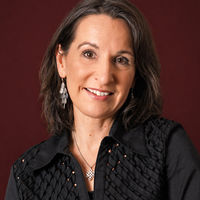
Zoe Knighton
cello
Zoe Knighton is at the forefront of a new generation of performers intent on forging an innovative path for the enjoyment of classical music. A founding member of Flinders Quartet, she is a leading Melbourne cellist and chamber musician.
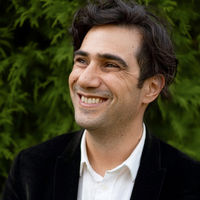
Amir Farid
piano
Amir Farid has been described as a highly creative musician – a pianist of great intelligence and integrity who brings strong musical substance to all that he does, imbuing it with his own experience and understanding, and who distinguishes himself for all the right reasons.
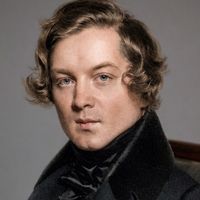
Robert Schumann
composer
Robert Schumann (1810–1856) was a German composer and music critic of the early Romantic era. His piano works and songs remain among the most enduring of the period.

Clara Schumann
composer
Clara Schumann's chamber and piano works speak with lyrical warmth and intimate Romantic colour. Her Notturno and Three Romances, Op. 22, carry melodic lines that sit naturally under the fingers and in the ear, music shaped for the salon and the recital stage.
Digital booklet
Digital booklet Notes, texts and credits — read online or download the PDF Download the PDFPerformers
- Zoe Knighton · cello
- Amir Farid · piano
Details
- List price
- $25.00 AUD
- Total playing time
- 66 minutes 14 seconds
- Release date
- 30 Sep 2021
- Category
- Classical
- Musical work copyright
- © 2021 Move Records
- Sound recording copyright
- ℗ 2021 Move Records
- Catalogue
- MD 3461
- EAN
- 9314574346121
More to explore
Brahms Cello
Zoe Knighton and Amir Farid present their seventh cello–piano collaboration, turning to Johannes Brahms. The programme pairs his two cello sonatas with three songs in which the cello takes the vocal line wordlessly.
Bach Cello
Debate still rages over the origins and purpose of Bach’s cello suites. Were they written for court cellists Christian Ferdinand Abel and Christian Bernhard Linke, for the unusual violoncello da spalla, or as progressive exercises for Bach himself?
Northern Cello
Music for cello from northern European composers. Zoe Knighton and pianist Ian Munro centre the programme on Grieg’s romantic sonata, with Sibelius’s Op. 78 pieces, Vasks’s solo Gramata Cellam and Pärt’s Fratres.
Russian Cello
Enter the world of Russia. Zoe Knighton and Amir Farid present unknown works alongside much-loved classics. The recording celebrates a romanticism in composition inspired by the combination of cello and piano.
A Little French Cello
A charming collection from the rich French school of the late nineteenth century. Cello sonority and piano clarity make the programme both approachable and moving. Zoe Knighton and Amir Farid are masters of their art.
Beethoven Cello
Cellists often bemoan the lack of a cello concerto by Beethoven – and rightly so, but these eight works for cello and piano are the envy of many other instruments. The complete cello sonatas and variations of Beethoven are here on this two-CD set.
Argentine Cello
More than Piazzolla alone: seven Argentine composers shape a cello-and-piano programme of tango, pampas colour and lyric nationalism, played by Zoe Knighton and Amir Farid.

Mendelssohn Cello
Mendelssohn is often cast as a composer who lived a charmed life, and whose music therefore lacks depth. The glory of that music, its likeability, and his gift for celebrating humanity remain primary reasons for its lasting hold.