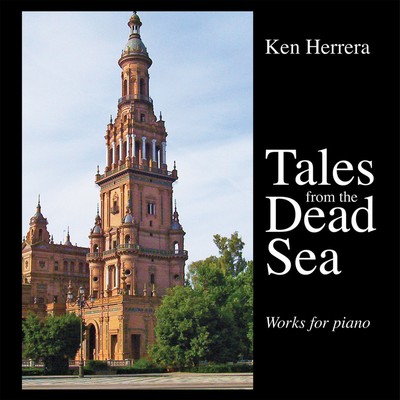
Listen & tracks
5 works · 63:14
-
1 Tales from the Dead Sea Ken Herrera 9:53
-
Six Preludes for the Left HandKen Herrera 6 movements19:29
- 2 i. Little Bells 3:39
- 3 ii. Monsieur le Pauvre 3:14
- 4 iii. Desde el Patio de los Naranjos 2:49
- 5 iv. Pastorale 3:01
- 6 v. Un Tanguito 2:36
- 7 vi. La Madrileña 4:10
-
Four Little PiecesKen Herrera 4 movements11:18
- 8 i. Prelude 1:34
- 9 ii. Waltz 2:37
- 10 iii. Scherzino 2:13
- 11 iv. Minuet-March 4:54
-
Piano SonataKen Herrera 2 movements16:15
- 12 i. Allegro appassionato 8:12
- 13 ii. Fantasia – Largo, quasi improvisato 8:03
-
14 Nocturne Ken Herrera 6:19
From these he creates a sound world that is both peculiar to him and firmly entrenched in the classical tradition.
The music on this disc showcases some of the most important trends in Herrera's career to date, including the first works in his series of sonatas and nocturnes, a suite for learners, and the Preludes for the left hand alone. Performed by the composer himself, they offer a fascinating introduction to the works of a young Australian artist.
In the artist’s words
Tales from the Dead Sea (2007)
This rhapsody has no specific program, but rather seeks to capture something of the timeless feel of an Old Testament story. Those who are familiar with my music will have recognised my fondness for the music of the Middle East, and the way that it has combined itself with other musical cultures – most notably that of North Africa, and from there to Spain, creating at each stage something rich and different. The use of drone tremolos, melismas and augmented second intervals are all attempts to suggest this musical heritage. Although it is quite free in form, as befits a rhapsody, the piece is constructed around a group of themes which provide the melodic, harmonic and rhythmic foundation for the rest of the music. It is also an example of the kind of structure that I frequently employ in my longer pieces – that of narrative. It may not have any kind of overarching Beethovenian logic in it, but I hope it does have the logic that a gifted storyteller brings to their tale. And what is the story? That, of course, is up to you.
Six Preludes for the Left Hand (2007)
When I returned to composing after a break of several years, I began using more improvisation in the early stages of writing a piece. However, I found my left hand falling into fairly unimaginative accompaniment patterns. To combat this, I decided to compose a set of pieces in which the left hand would be responsible for everything. They do not try to give the illusion of two hands, but rather aim to show what is possible musically with fairly limited resources.
The first prelude, Little Bells, is inspired by the gamelan music of Indonesia, in which sounds from the bell-like instruments are allowed to build up in fascinating conglomerations of sound. Others have also heard the improvisatory cacophony of the Western bell-ringing tradition, and who am I to say they are wrong? Monsieur le Pauvre (Mr. Poor) was the nickname of Erik Satie, and this piece has something of the feel of his early, meditative piano works, with a hint of his trademark quirkiness as well. The name Desde el Patio de los Naranjos (From the Patio of the Oranges) refers to the patio in front of the mosque in Córdoba, which looked out over the Jewish quarter during the Moorish occupation of Spain. The sombre, portentous opening gives way to a ferocious passage in irregular time – some medieval Moorish musician doing what he can to excite his listeners, perhaps. Like a traditional Pastorale, the fourth piece is built around drones and slow moving harmonies. To complete the picture, an itinerant cuckoo can be heard as well. Although Un Tanguito (A little tango) does not sound like a traditional tango, this piece does use some of the ornamentation that is common in the Argentine tango piano style. La Madrileña (The woman of Madrid) is shot through with flamenco, with specific imitation of cante jondo (deep song) and certain guitar effects. Structurally, it is a set of short, but quite wide-ranging variations on the opening theme.
Four Little Pieces (2009)
The twentieth century saw less and less music being written for people who were not professional musicians, with corresponding consequences (in my opinion) for people’s appetite for new music. With this in mind, these pieces were written to be within the reach of a moderately talented amateur. I make a point of playing them in concert because this ensures that I don’t let the pieces become boring – the terrible fate of too many works written for learners! This set of four is linked by the different keys that are used, and also by an alternation of fast and slow pieces. The Prelude is a singing piece which bowls along happily, with a cheerful melody flowing over a simple accompaniment. Second is a Waltz – a melancholy one in G minor in this case. A tranquil centre in C major provides a still point in the piece. The third piece, Scherzino, is a madcap dash almost from beginning to end, using irregular phrases, and unexpected pauses to keep the listener off guard. Lastly comes the Minuet-March, the most difficult piece of the set, which sets the stately dance of the minuet against a more martial rhythm, with some interesting results.
Piano Sonata (2008)
i. Allegro appassionato
ii. Fantasia – Largo
What does the word sonata mean in this day and age? Essentially, whatever the composer wants it to – but to me it suggests a certain grandeur and ambition in conception that will shine through whether the piece goes for thirty minutes or thirty seconds (now there’s a compositional challenge for the future.)
This piano sonata shows my continuing fascination with the musical culture of Spain. The tonality of the work as a whole moves from E flat (major and minor) in the first movement, to E in the second, with frequent use of the Phrygian mode that is so common in flamenco music.
The first movement, in a fairly traditional sonata form, begins with a dramatic introduction that suggests the guitar. Both of the main themes, however, are vocal in character – the first is something of a folk song, and the second suggests the timeless quality of medieval plainchant.
In the second movement, the flamenco references become much more overt, and this ‘fantasia’ uses its many tempo changes, strumming effects and unmeasured passages to create something of the feel of a group of musicians improvising together.
Nocturne (2008)
This piece is very much in the vein of night works by other composers such as Chopin and Liszt. It follows an arch form, and moves from rippling arpeggios to repeated chords and back again, always with the melodies singing over the top. Again, there is no particular program – the idea of ‘night music’ is all one needs to know in order to come to grips with the piece.
Artists

Ken Herrera
piano
Ken Herrera is an Australian pianist and composer. His solo piano music embraces melody and a wide span of colour, from flamenco and tango to French impressionism and Middle Eastern inflection.
Digital booklet
Digital booklet Notes, texts and credits — read online or download the PDF Download the PDFPerformers
- Ken Herrera · piano
Technical credits
-
Recording Engineer
Vaughan McAlley
-
Venue
Move Records Studio
Details
- List price
- $25.00 AUD
- Total playing time
- 63 minutes 14 seconds
- Release date
- Jun 2012
- Categories
- Classical, Keyboard
- Musical work copyright
- © 2012 Ken Herrera
- Sound recording copyright
- ℗ 2012 Ken Herrera
- Catalogue
- MCD 473
- EAN
- 9314574047325
More to explore
Tango Fantasy
An alluring Latin American odyssey: Ken Herrera’s solo piano programme of original tangos, a Baroque-tinged suite and a sultry nocturne that lean into waltz, milonga, bossa nova and blues.

Aurora Borealis
Pianist and composer Ken Herrera draws inspiration from across the world and the full colour of the musical spectrum. Embracing melody and meaning, he charts an independent course in contemporary waters.