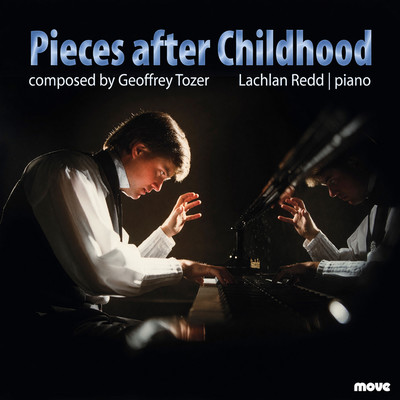
Listen & tracks
4 of 20 tracks have a preview · 9 works · 67:04
-
Sonata in C (1978)Geoffrey Tozer 3 movements14:30
- 1 Dolce 6:49
- 2 Andante 3:48
- 3 Allegro 3:53
-
4 Prelude in C sharp major (1978) Geoffrey Tozer 6:06
-
5 Fugue in C sharp major, 4 voices (1978) Geoffrey Tozer 8:14
-
Two Part Inventions (1972)Geoffrey Tozer 4 movements7:23
- 6 Andante 1 1:37
- 7 Allegro 2:25
- 8 Largo 2:05
- 9 Andante 2 1:16
-
Suite for Ben (Benjamin Britten) (1988)Geoffrey Tozer 3 movements4:51
- 10 Prelude 2:00
- 11 Minuet 2:08
- 12 Gigue :43
-
Citrus (1978)Geoffrey Tozer 5 movements18:07
- 13 Praeludium and Fughetta in C 3:25
- 14 Praeludium and Fughetta in B flat 3:02
- 15 Lemon Tree Fugue 2:11
- 16 Invention and Fugato 4:31
- 17 Tripos 4:58
-
18 Heimweh (Homesickness) (1978) Geoffrey Tozer 4:11
-
19 Reuben (1974) Geoffrey Tozer 3:01
-
20 Arpeggionata (1988) Geoffrey Tozer :41
A companion to Pieces from Childhood, this disc turns to the mature Tozer: counterpoint-rich inventions and the Citrus suite, the formidable Prelude and Fugue in C sharp written for the 1978 Tchaikovsky Competition, the searching Heimweh, and the brief Suite for Ben in tribute to Benjamin Britten.
Redd is the first pianist to bring these scores into public performance. The writing asks for a wide hand and a clear ear for four-voice texture, yet it also yields simple, memorable melody, nowhere more so than in the opening of the Sonata in C.
In the artist’s words
The growth in musical maturity and originality is evident in these works, as is the influence of Tozer’s travels, study and performances both in Australia and overseas. The maturity of Tozer the musician was apparent at a very early age, but he was unknown as a composer, who was in ‘hibernation’ while the concert artist blossomed and succumbed to the demands of an international career. Fortunately, Tozer did on occasion commit his music to paper and we can now share what he had to say through his own music.
Tozer had a lifelong fascination with counterpoint. This is clear in the Two Part Inventions, the fugues composed for his Citrus suite and more especially in the Fugue in C sharp written for the Tchaikovsky Competition in Moscow in 1978. The Fugue and the Prelude (also in C sharp) take the listener and any performer with the technical skills necessary to play it (a stretch of at least a 10th in the left hand is a prerequisite) on a contrapuntal and harmonic journey of intrigue and excitement, as it weaves the four voices throughout the entire range of the keyboard. The Prelude, with its score demanding one complete system per bar, could attract the same idiosyncratic criticism as Mozart’s music: “too many notes”. Tozer’s Prelude is even more virtuosic than the Fugue, and like many works of Nikolai Medtner, whom Tozer championed, it is relentless from the first bar to the last in the full five minutes and forty seconds its performance requires.
The Sonata in C, the last of his nine piano sonatas, in my opinion, is the most inspiring and appealing. It begins with an unforgettable melody that should be dedicated to Mozart, for its simplicity and beauty and for the way Tozer develops and ornaments it. In the three movements of the Sonata, one hears the journey Tozer has made both harmonically and melodically – sometimes quite predictable, but often unexpected and unique in the twists and turns it takes.
Tozer is revealed as a more mature, unique, eclectic composer in the soul-searching Heimweh composed in Jerusalem in 1978, which draws us into some of the pain he has already felt and is yet to confront; Reuben is more of a light-hearted joke, a musical evocation of Reuben Fineberg, the Jewish impresario who was to influence and guide much of Tozer’s life and performing career right up to Fineberg’s death in October 1996. The Arpeggionata and Suite for Ben were written during Tozer’s extraordinary sojourn as a part-time music teacher in Canberra in 1988. Tozer composed Arpeggionata to express to teenage schoolboys the sheer joy and brilliance of playing arpeggios all over the piano. He composed Suite for Ben as a lovely tribute to his own musical hero Benjamin Britten, whom he met and by whom he had been mentored when he himself was a teenager.
Lachlan Redd is the first pianist to perform these pieces and fortunately has a span of a tenth!
The question has been asked of me many times, would Geoffrey want ‘his compositions’ to be heard in public? This is an interesting tease, for it assumes that Geoffrey only wanted to play these pieces for himself. This may also be part of the picture in raising the issue of personal (private) musical reflections, as opposed to public and overt displays of virtuosity in performance.
What we do know, on examining these more mature works, is that they range in both style and sophistication. (We note the Pieces from Childhood likewise demonstrate the composer’s mastery and acknowledgement of style.)
The actual texts reveal different stages in the artistic process for Geoffrey: some experimental and ‘sketchy’; others neatly revised in several versions. (The complicated Prelude and Fugue is one notable example.) Did the fact that Geoffrey performed the Fugue in Russia indicate he endorsed public performance of his works for future generations?
What will be interesting to the listener (and the curious student) is that these Pieces after Childhood display the complex characteristics of the pianist/composer, in the various stages of his performing life and career. Be it the expression of an artist away from home, or the artist at home in preparation for a series of competitions or tours, or the output, perhaps, as a measure of his much needed ‘downtime’. Whatever the verdict, these works reflect a release for such an artist, who in demand found composition a reprieve from the rigours of the concert platform.
The virtuosic demands in most of the Pieces after Childhood may be beyond the technical reach of many pianists, but the challenge of following the scores and gaining some insight into this interesting and diverse music is here for the curious listener as well.
Reviews
Tozer belonged to a small and rarefied stratum of world pianists. In terms of musical comprehension, intellectualism and facility, Geoffrey’s talent was simply off the scale. He could arrange, orchestrate, compose and improvise; indeed, improvisation was one of his specialties.
Artists
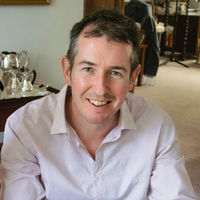
Lachlan Redd
piano
Concert pianist Lachlan Redd came to international attention when, aged just twenty, he won First Prize in the prestigious Virtuosi of the Year 2000 competition in St Petersburg.

Geoffrey Tozer
composer
Geoffrey Tozer (1954–2009) was an Australian concert pianist and composer of the first rank, gifted with perfect pitch, a boundless musical memory, and the ability to improvise, transpose instantly into any key, or reduce an orchestral score at sight.
Digital booklet
Digital booklet Notes, texts and credits — read online or download the PDF Download the PDFPerformers
- Lachlan Redd · piano
Technical credits
-
Recording Engineer
Martin Wright
Vaughan McAlley
-
Editing Engineer
Vaughan McAlley
-
Mastering Engineer
Martin Wright
-
Venue
Move Records Studio
Details
- List price
- $25.00 AUD
- Total playing time
- 67 minutes 4 seconds
- Release date
- 6 Nov 2017
- Category
- Classical
- Musical work copyright
- © 2017 Move Records
- Sound recording copyright
- ℗ 2017 Move Records
- Catalogue
- MD 3417
- EAN
- 9314574341720
More to explore
Pieces from Childhood
Geoffrey Tozer’s Pieces from Childhood offer a brief window onto a young genius finding his way in classical music. The emotions he shapes – sometimes tumultuous, sometimes meditative – are the embodiment of a growing artist.
Geoffrey Tozer in Concert: Auckland 1990
Recorded live with the Auckland Symphonia under Vladimir Verbitsky, Geoffrey Tozer plays Rachmaninov’s complete Rhapsody on a Theme of Paganini, Op. 43, and Liszt’s Hungarian Rhapsody No. 2.
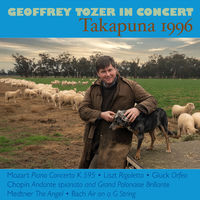
Geoffrey Tozer in Concert: Takapuna 1996
A live 1996 concert from Takapuna captures Geoffrey Tozer with the Auckland Sinfonietta in Mozart’s Piano Concerto No. 27, framed by Chopin, Medtner, Schnabel, Gluck, Liszt and Bach.
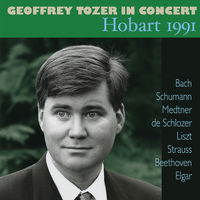
Geoffrey Tozer in Concert: Hobart 1991
Live solo piano recital by Geoffrey Tozer, recorded at the University Centre, Hobart, on 18 May 1991. Bach’s Italian Concerto and Schumann’s Carnaval open a programme that also takes in Medtner, Liszt, Beethoven and Elgar.
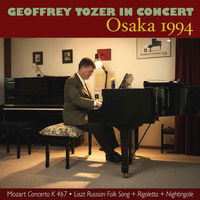
Geoffrey Tozer in Concert: Osaka 1994
Live from Osaka in 1994, Geoffrey Tozer partners the Osaka Symphony Orchestra in Mozart’s Piano Concerto No. 21 in C major, K. 467, then turns to three Liszt piano works.
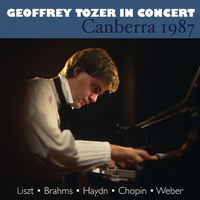
Geoffrey Tozer in Concert: Canberra 1987
This live recording of pianist Geoffrey Tozer was made in June 1987, during a series of four recitals marking his twenty-fifth anniversary as a performer.