Geoffrey Tozer
Geoffrey Tozer (1954–2009) was an Australian concert pianist and composer of the first rank, gifted with perfect pitch, a boundless musical memory, and the ability to improvise, transpose instantly into any key, or reduce an orchestral score at sight.
Born in India on 5 November 1954 and raised in Melbourne, he showed prodigious ability from childhood and made his first recording in 1963. Across nearly fifty years he gave recitals and concerts on five continents, with a vast concerto repertoire and a particular championship of Medtner. His awards included two Churchill Fellowships, two Rubinstein Medals, the Diapason d’Or and a Grammy nomination—the only Australian pianist so honoured. As a Chandos artist he made thirty-four distinguished recordings, with further commercial discs and hundreds of broadcast performances for Australian companies and the ABC.
Live concert documents capture him at full stretch, among them Geoffrey Tozer in Concert: Canberra 1987 (MD 3382), Auckland in 1990, Hobart in 1991, Osaka in 1994, and the Takapuna performance of Mozart’s final piano concerto on Geoffrey Tozer in Concert: Takapuna 1996 (MD 3387). In China he performed the Yellow River Concerto before enormous television audiences.
He was also a composer. Childhood manuscripts and later works, unknown and unpublished at his death, have since been edited and recorded on Pieces from Childhood (MD 3377) and Pieces after Childhood (MD 3417), revealing a lifelong fascination with counterpoint and an ear already tuned to the styles he played.
Press quotes
He was a superb accompanist and a generous collaborator in chamber music, and he was also a composer. After his untimely death on 21 August 2009, journalist James Campbell described him as ‘Australia’s greatest and most recorded pianist’. Across a professional career of nearly fifty years he matured into an artist of international renown, with recitals and concerts on five continents. His awards included the Winston Churchill Fellowship (twice), the Rubinstein Medal (twice), the Diapason d’Or and a Grammy nomination for Best Classical Performance—the only Australian pianist so honoured.
Tozer belonged to a small and rarefied stratum of world pianists. In terms of musical comprehension, intellectualism and facility, Geoffrey’s talent was simply off the scale. He could arrange, orchestrate, compose and improvise; indeed, improvisation was one of his specialties.
Geoffrey Tozer is featured on the following titles
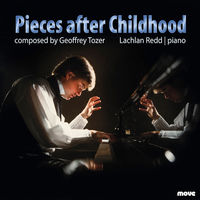
Pieces after Childhood
The remarkable compositions of Geoffrey Tozer were almost entirely unknown and unpublished at the time of his death in 2009. This premiere recording features nine works for piano composed during the years 1972–1988, performed by Lachlan Redd.
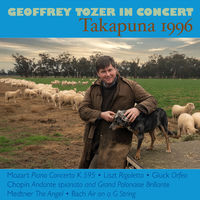
Geoffrey Tozer in Concert: Takapuna 1996
A live 1996 concert from Takapuna captures Geoffrey Tozer with the Auckland Sinfonietta in Mozart’s Piano Concerto No. 27, framed by Chopin, Medtner, Schnabel, Gluck, Liszt and Bach.
Arranger
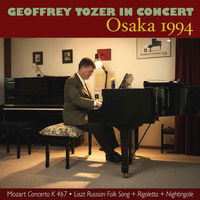
Geoffrey Tozer in Concert: Osaka 1994
Live from Osaka in 1994, Geoffrey Tozer partners the Osaka Symphony Orchestra in Mozart’s Piano Concerto No. 21 in C major, K. 467, then turns to three Liszt piano works.
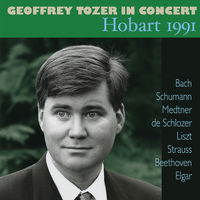
Geoffrey Tozer in Concert: Hobart 1991
Live solo piano recital by Geoffrey Tozer, recorded at the University Centre, Hobart, on 18 May 1991. Bach’s Italian Concerto and Schumann’s Carnaval open a programme that also takes in Medtner, Liszt, Beethoven and Elgar.
Arranger
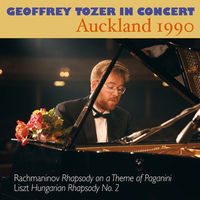
Geoffrey Tozer in Concert: Auckland 1990
Recorded live with the Auckland Symphonia under Vladimir Verbitsky, Geoffrey Tozer plays Rachmaninov’s complete Rhapsody on a Theme of Paganini, Op. 43, and Liszt’s Hungarian Rhapsody No. 2.
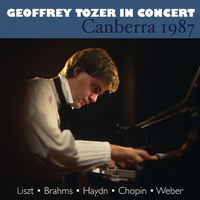
Geoffrey Tozer in Concert: Canberra 1987
This live recording of pianist Geoffrey Tozer was made in June 1987, during a series of four recitals marking his twenty-fifth anniversary as a performer.
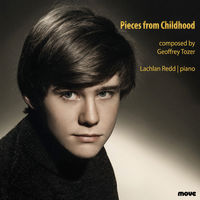
Pieces from Childhood
Geoffrey Tozer’s Pieces from Childhood offer a brief window onto a young genius finding his way in classical music. The emotions he shapes – sometimes tumultuous, sometimes meditative – are the embodiment of a growing artist.