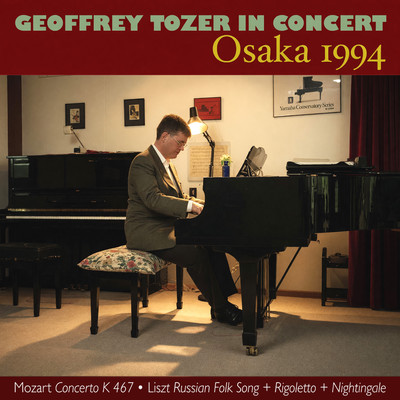
Listen & tracks
2 of 6 tracks have a preview · 4 works · 41:28
-
Concerto for Piano and Orchestra no. 21 in C major, K. 467Wolfgang Amadeus Mozart 3 movements27:43
- 1 i. Allegro 13:39
- 2 ii. Romance 6:42
- 3 iii. Rondo. Allegro assai 7:22
-
4 Russian Folk Song Franz Liszt 2:56
-
5 Rigoletto Franz Liszt 6:45
-
6 Nightingale Franz Liszt 4:04
The programme opens with the three movements of the C major concerto, then moves to Liszt’s Russian Folk Song, the Rigoletto paraphrase, and Nightingale.
The release preserves a Japanese concert from the height of Tozer’s international career, issued on Move after his death.
In the artist’s words
Geoffrey Tozer was an artist of the first rank, a consummate musician, a concert pianist and recitalist with few peers, possessing perfect pitch, a boundless musical memory, the ability to improvise, to transpose instantly into any key or to create on the piano a richly textured reduction of an orchestral score at sight. He was a superb accompanist and a generous collaborator in chamber music. He was also a composer.
Tozer composed from childhood and left more than 160 compositions several of which he performed publicly in Australia and overseas. His prodigious abilities were recognised early in his childhood and during a professional career that lasted for nearly fifty years he developed into a mature artist, fully realising his abilities and earning renown around the world with recitals and concerts on five continents. He made his first recording in 1963 and, as an exclusive artist of Chandos during his adult career, produced thirty-four recordings of distinction, six commercial recordings for several Australian record companies and hundreds of other recordings mainly for the Australian Broadcasting Corporation, including complete concertos of Bach, Beethoven, Mozart and Medtner on film. Tozer won numerous awards during his career including the Winston Churchill Fellowship (twice, Australia), the Australian Creative Artists Fellowship (twice, Australia), the Rubinstein Medal (twice, Israel), the Alex de Vries Prize (Belgium), the Royal Overseas League (United Kingdom), the Diapason d’Or (France), the Liszt Centenary Medallion (Hungary) and a Grammy Nomination for Best Classical Performance (USA), becoming the only Australian pianist to achieve such distinction.
Geoffrey Tozer died on 21 August 2009 at the age of just fifty-four. After Tozer’s untimely death, journalist James Campbell described him in the media as ‘Australia’s greatest and most recorded pianist’. Tozer’s greatness is certainly evident in his recorded output and witnessed by his vast performance history which exceeds that of any other Australian pianist. Esteemed Australian pianists such as Eileen Joyce, Noel Mewton-Wood, Percy Grainger and Roger Woodward among those whom Tozer admired, certainly achieved greatness, but few pianists anywhere can rival Tozer’s repertoire or his output of recorded performances. The body of more than 600 recordings which Tozer produced between 1963 and 2009 fully justified Campbell’s description. Today many of Tozer’s recordings can be found in the ABC archives. They, along with other recordings by Tozer housed in the MBS radio archives in Melbourne and Sydney, the BBC archives in London and in archives in Israel, China, Hungary, Germany, Finland, Italy, Russia, Mexico, New Zealand, Japan and the United States, form an important part of Tozer’s musical legacy; a gift of national and international importance in music.
Throughout his career Tozer resisted the frequent calls that he permanently re-locate to the northern hemisphere and sign with a major international agent. Whatever this cost him in career terms, he proved it was possible to achieve international renown as a pianist while based permanently in Australia. His overwhelming motivation was always to bring music to the people whether this meant playing for a local audience or piano students in regional China, giving a Master Class in Mexico City or performing for three weeks on a tour of country towns in South Australia. He was invariably motivated to use his talents to make music at every opportunity, and regarded this as a duty which was more important than whether the performances themselves took place in the Australian outback, the Sydney Opera House, the Royal Albert Hall, the Arts Centre in Gulangyu, China, or in Carnegie Hall. By March 2009, when Tozer gave what proved to be his final concerts for large audiences (30,000 people) at the Sydney Entertainment Centre, he had performed in at least forty countries over a period of forty-six years with many of the world’s major orchestras and conductors. As an exclusive artist of Chandos he had produced a series of recordings which had brought him acclaim as a ‘grand master’ of his instrument and which, in their quality and diversity, became a testament to his musical genius.
Tozer was conceived in Tasmania, but was born in India on 5 November 1954. He lived there with his mother Veronica and brother Peter until October 1958 when the family moved to Melbourne. Tozer’s father was Geoffrey Conan-Davies, a brilliant scholar who had been educated at Bromsgrove and, from the age of fifteen, at Keble College, Oxford University. Speaking in Berlin in 2001, Tozer recalled,
‘I was born in the Indian Himalayas in a small town high above the winter snowline called Mussoorie. The first music I heard in my cot was my mother playing and teaching the piano, and Beethoven works played on the windup gramophone by Artur Schnabel.’
Veronica Tozer was herself a gifted musician and pianist. Recognising the prodigious gifts which her young son possessed, she decided to re-locate to the musical city of Melbourne. It was there, on 15 April 1963 that the eight year old Tozer gave his first public performances to be preserved on recording: a recital, organised by Marjorie McAlpin, for which Tozer played music of Bach, Mozart, Beethoven, Pergolesi and Bartok. Later his mother wrote in her diary that the young pianist had performed well: ‘Geoffrey showed his ability to work for perfection …despite some laboured playing.’ During the year Tozer made extremely rapid progress. On 27 August 1963, he gave his first broadcast recital on ABC radio, playing Bach Preludes No 4 and No 5 and Beethoven’s Sonata Opus 49 No 2. Several weeks later he performed Bach’s Concerto in F Minor with the Melbourne Symphony Orchestra for an ABC television broadcast. On 13 April 1964 he performed the same concerto with the Astra Chamber Orchestra conducted by George Logie-Smith at the Nicholas Hall in Melbourne. Felix Werder, music critic for The Age wrote:
‘An interesting feature of the concert was the debut of nine year old Geoffrey Tozer as soloist. It was a performance of great charm that would have done credit to a seasoned campaigner, displaying fine musical talent and a natural instinct for a Bachian phrase, particularly beautifully realised in the arioso.’
The previous summer, while on holidays in Tasmania, the young Tozer had met Eileen Ralf, the pianist whose teaching he later described as ‘the greatest musical gift given to me’. To assist the young prodigy, Trans Australian Airlines gave Tozer unlimited free travel between Melbourne and Hobart so that Tozer could have weekly lessons with Eileen Ralf in Hobart. During the next five years, under the watchful eyes of Ralf and her husband Thomas Matthews, Tozer became an experienced, fledgling concert pianist, giving numerous recitals and more than forty concerts with the major orchestras in various Australian cities. He performed concertos of Bach and Grieg, the first movement of Brahms Piano Concerto No. 1, the five Beethoven concertos, Haydn’s Piano Concerto in D Hob XVIII for a large audience at the Sidney Myer Music Bowl, Melbourne in February 1965 when he was just ten years old and at least nine Mozart Concertos, including Concerto 10 K 365 for two pianos which he performed with Eileen Ralf and the Tasmanian Symphony Orchestra conducted by Matthews on 19 May 1968. For these achievements he became the youngest recipient in the world of the Winston Churchill Fellowship when he was thirteen, moving to England to further his studies in 1969.
Tozer constantly composed during the years of his early musical development. By the time he moved to London, he had produced more than 120 compositions and, at times, had contemplated a career as a composer, rather than as a performer. However, by the age of thirteen, his sheer brilliance on the piano and the constant, consuming impulse to perform meant that his career pathway was set. Although he would continue to compose from time to time, particularly during 1978 when he attained new heights of brilliance with several adult compositions, the majority of his compositional work took place during his years as a child prodigy.
Veronica Tozer’s detailed, chronological diaries are replete with references to her young son’s compositions. On 10 February 1963, Waldemar Seidel visited the Tozers at home to hear Geoffrey play. Decades earlier Seidel had taught the young Noel Mewton-Wood and he was ‘amazed’ by the young pianist who now sat before him. Veronica Tozer recorded that, ‘It was a very nice evening – Geoffrey played his own compositions and wanted W. Seidel to see all of his composition books’. Most of the compositions were for piano, but sometimes the young Tozer would compose for other instruments, developing some of his manuscripts from improvisations. One Saturday morning, on 21 March 1963, his mother noted that ‘Geoffrey was improvising in a masterly manner on his violin’. In October she wrote that, ‘He has composed Variations on Green Sleeves written down only in a rough outline, but plays a complicated woven stream of legato that puzzled me at first for its vague familiarity – a very effective variation indeed which he likes playing. Another is in the style of a horn pipe!’ On 10 November 1963, five days after Tozer’s ninth birthday, his mother provided some rare insights into the form, meaning and value of Tozer’s impulse to compose when she wrote, sic:
‘It is a very long time since Geoffrey felt as free to improvise as he did last night. I think it is important for Geoffrey to think out his feelings at the piano – he is experimenting all the time, and ideas flash into his mind and return to be developed, a turn of phrase will remind him of something he has heard or knows, and you see it grow only to laughingly hurtle into something else held together by brilliant scale and arpeggio passages – trills and single reitterated notes as if searching for the next opening. His performance was non stop and I eventually had to break the spell to get him unwound for sleep. He was exhausted. I feel happier about him.’
Between 1969 and 1971, Tozer lived in England earning considerable distinction in Britain and Europe. In 1969 he became the youngest ever semi-finalist in the Leeds Piano Competition, later winning First Prize in both the Alex de Vries Piano Competition in Belgium and the Royal Overseas League Competition in London. He made his international debut on 17 August 1970 in London at a Promenade Concert in the Royal Albert Hall playing Mozart’s Piano Concerto No 15, K 450 with the BBC Symphony Orchestra conducted by Colin Davis. Important engagements followed with Tozer giving performances in Belgium, Denmark, Ireland, France and Britain, including invitations from Daniel Barenboim’s English Chamber Orchestra and from Benjamin Britten to perform at the 1971 Aldeburgh Festival. Tozer distinguished himself at Aldeburgh both as a recitalist and as an accompanist for the great cellist Rostropovich. During the European tour a Belgian newspaper confidently predicted that, ‘Geoffrey Tozer will become one of the greatest pianists in the world.’ If greatness is measured by the quality of sound produced by an instrumentalist, by the ability to interpret music so as to move an audience through a gamut of emotions while demonstrating a unique sensibility and phenomenal piano technique, by a coverage of the repertoire that rivaled that of Sviatoslav Richter, by pianism of the highest standards for more than forty years and by a love of music that sustained an international career for four decades, performing on every continent while living mostly in Australia, then Tozer has an assured place among the great pianists.
By 5 November 1994, when Tozer celebrated his fortieth birthday in Melbourne he had scaled the peaks of the repertoire, reaching the pinnacle many times and was riding a huge wave of success, unprecedented for an Australian pianist. Recent highlights had included the Australian premiere of the Medtner Piano Concerto No 1 in C Minor Opus 33 with the Canberra Symphony Orchestra (1992), the Medtner Piano Concerto No 2 in Finland, a performance conducted by Leif Segerstrom and broadcast in Europe (1993), Tozer’s first tour of China at the invitation of the Ministry of Culture, with recitals in Beijing, Shanghai, Nanjing and other cities (1993), the complete sonatas of Beethoven at the Melbourne International Festival (1994) and Mozart’s Piano Concerto No. 21 in Japan (1994). The wave of success continued internationally until 2004, but came to a premature end in Australia at the Sydney Opera House on April 12, 1996. That night Tozer gave one of the most astounding performances of his career when, in the first half of the concert program, he played Mozart’s Piano Concerto in D Major K 175 and followed this minutes later with Prokofiev’s Piano Concerto No 3 in C Opus 26. Few pianists in the world would dare to undertake such a feat, but Tozer gave superlative accounts of both concertos and they were broadcast on ABC radio on 19 April 1996. For reasons that have yet to be fully explained, Tozer was never again invited to perform with any of the major Australian orchestras. He quickly became aware of this and, in 1997, in a front-page newspaper story, pointed out that, ‘It’s a waste to have someone like me here, not being used’, thereby putting the Australian music industry on notice, in case they had missed the point. Fortunately, from 1997 for the next seven years, Tozer’s schedule of international engagements was busier than ever and he scaled new heights of musical achievement, giving some of the finest performances of his career. These included Tozer’s London premiere performance and recording of the Roberto Gerhard Piano Concerto (Gramophone Critics’ Choice, 1998), his Berlin Festival performances of the Schabel Sonata and other Schnabel compositions (2001), and his performances in China, also broadcast live on Chinese national television, of the Yellow River Concerto (2001 and 2002).
Tozer’s private funeral was held in the Windsor Convent Chapel which was filled to capacity with close friends and relatives. Four weeks later, in accordance with Tozer’s wishes, his Memorial Service was held at St Patrick’s Cathedral in Melbourne. During the service Rosamund Illing sang a moving rendition of Schubert’s Ave Maria. Then the former Prime Minister of Australia Paul Keating who, since 1989 had been Tozer’s greatest and most important patron, galvanised the congregation of more than four hundred people with his impassioned eulogy, lamenting the loss of such an irreplaceable artist.
Artists

Geoffrey Tozer
piano
Geoffrey Tozer (1954–2009) was an Australian concert pianist and composer of the first rank, gifted with perfect pitch, a boundless musical memory, and the ability to improvise, transpose instantly into any key, or reduce an orchestral score at sight.
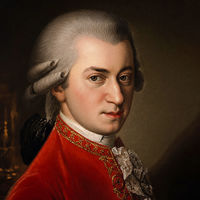
Wolfgang Amadeus Mozart
composer
Wolfgang Amadeus Mozart was a prolific and influential composer of the Classical era. He wrote over 600 works, many of them pinnacles of symphonic, concertante, chamber, piano, operatic and choral music, and remains among the most enduringly popular of classical composers.
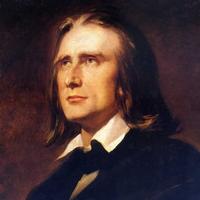
Franz Liszt
composer
Franz Liszt (1811–1886) was a Hungarian composer, virtuoso pianist, conductor and teacher of the Romantic era. His vast output reshaped piano technique, invented the symphonic poem and pushed harmony toward the twentieth century.
Digital booklet
Digital booklet Notes, texts and credits — read online or download the PDF Download the PDFPerformers
- Geoffrey Tozer · piano
- Osaka Symphony Orchestra · orchestra · tracks 1–3
Technical credit
-
Contributor
Peter Wyllie Johnston
Details
- List price
- $20.00 AUD
- Total playing time
- 41 minutes 28 seconds
- Release date
- 11 Dec 2014
- Category
- Classical
- Musical work copyright
- © 2014 Move Records
- Sound recording copyright
- ℗ 2014 Move Records
- Catalogue
- MD 3386
- EAN
- 9314574338621
More to explore
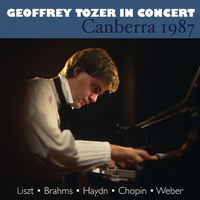
Geoffrey Tozer in Concert: Canberra 1987
This live recording of pianist Geoffrey Tozer was made in June 1987, during a series of four recitals marking his twenty-fifth anniversary as a performer.
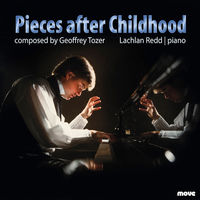
Pieces after Childhood
The remarkable compositions of Geoffrey Tozer were almost entirely unknown and unpublished at the time of his death in 2009. This premiere recording features nine works for piano composed during the years 1972–1988, performed by Lachlan Redd.
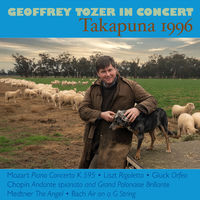
Geoffrey Tozer in Concert: Takapuna 1996
A live 1996 concert from Takapuna captures Geoffrey Tozer with the Auckland Sinfonietta in Mozart’s Piano Concerto No. 27, framed by Chopin, Medtner, Schnabel, Gluck, Liszt and Bach.
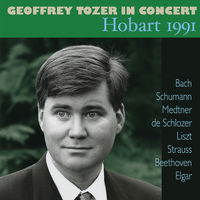
Geoffrey Tozer in Concert: Hobart 1991
Live solo piano recital by Geoffrey Tozer, recorded at the University Centre, Hobart, on 18 May 1991. Bach’s Italian Concerto and Schumann’s Carnaval open a programme that also takes in Medtner, Liszt, Beethoven and Elgar.
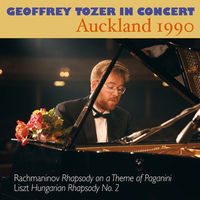
Geoffrey Tozer in Concert: Auckland 1990
Recorded live with the Auckland Symphonia under Vladimir Verbitsky, Geoffrey Tozer plays Rachmaninov’s complete Rhapsody on a Theme of Paganini, Op. 43, and Liszt’s Hungarian Rhapsody No. 2.
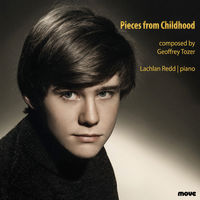
Pieces from Childhood
Geoffrey Tozer’s Pieces from Childhood offer a brief window onto a young genius finding his way in classical music. The emotions he shapes – sometimes tumultuous, sometimes meditative – are the embodiment of a growing artist.