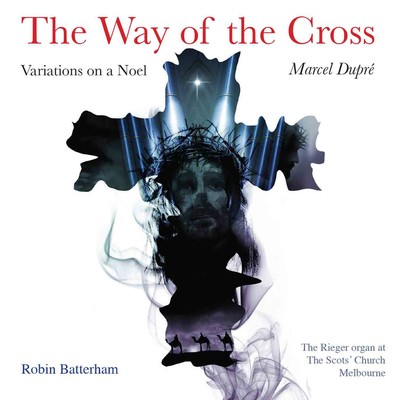
Listen & tracks
2 of 25 tracks have a preview · 2 works · 60:06
-
Le Chemin de la Croix, Op. 29Marcel Dupré 14 movements48:06
- 1 Station I: Jesus is condemned to death 3:04
- 2 Station II: Jesus carries His Cross 3:00
- 3 Station III: Jesus falls for the first time 3:49
- 4 Station IV: Jesus meets His Mother 3:16
- 5 Station V: Simon the Cyrene helps Jesus carry the Cross 2:30
- 6 Station VI: Jesus and Veronica 2:51
- 7 Station VII: Jesus falls for the second time 3:34
- 8 Station VIII: Jesus comforts the women of Jerusalem 4:02
- 9 Station IX: Jesus falls for the third time 3:22
- 10 Station X: Jesus is stripped of His garments 2:46
- 11 Station XI: Jesus is nailed to the Cross 3:44
- 12 Station XII: Jesus dies upon the Cross 3:38
- 13 Station XIII: The body of Jesus is taken down from the Cross and laid in Mary's bosom 2:59
- 14 Station XIV: The body of Jesus is laid in the tomb 5:31
-
Variations Sur un Noël, Op. 20Marcel Dupré 11 movements12:00
- 15 Theme – Moderato :55
- 16 Variation I – Larghetto :46
- 17 Variation II – Poco animato :37
- 18 Variation III – Canon à l'octave 1:14
- 19 Variation IV – Vif :30
- 20 Variation V – Vivace :53
- 21 Variation VI – Canon à la quarte et à la quinte :56
- 22 Variation VII – Vivace :44
- 23 Variation VIII – Canon à la seconde 1:31
- 24 Variation IX – Animé :47
- 25 Variation X – Fugato 3:07
The fourteen Stations follow Christ's passion from condemnation to burial in music first improvised to Paul Claudel's verses, then written down for the concert hall.
The companion set elaborates the medieval French carol Noël nouvelet through ten variations that range from intimate canons to a closing fugato and toccata.
In the artist’s words
Le Chemin de la Croix, Op. 29 (The Stations of the Cross) is a popular form of devotion in the Roman Catholic and some Anglican churches. It consists of meditations on fourteen pictures or carvings recalling the passion of Christ from his condemnation to death by Pilate and the sorrow of his Mother to his death on the cross and burial.
Le Chemin de la Croix (The Way of the Cross) enjoyed immediate recognition. It originated at a Brussels concert in February 1931 when Dupré improvised commentaries following the reading of fourteen verses of a poem by Paul Claudel (1868–1955). A plan for each movement, the registration and the use of melodic and rhythmic ideas had been worked out in advance. He had found the double leap of two fourths for the Cross in Bach, Handel and Schütz; the four notes rising conjunctly for Redemption occur in Handel's Messiah and Bach's St John Passion, as well as in Franck's Beatitudes and Wagner's Parsifal.
The audience reaction was so favourable that Dupré decided to write the work down, trying to evoke the same atmosphere. The written version was first performed in Paris in March 1932.
Variations on a Noel, Op. 20. One of his more frequently performed and recorded works, the Variations on a Noel was composed in 1922 while Dupré was touring the United States.
The theme is a mediaeval French Christmas carol Noël nouvelet, a tune sometimes used with the Easter text “Now the green blade riseth”. After the theme, ten variations follow showing many varieties and combinations of organ tone. French organists have traditionally had an affinity for elaborating Christmas melodies, but unlike his predecessors, Dupré is not content with mere melodic modifications. His approach is a subtle one, expanding not only the melody but also the rhythm and harmonies.
Variations three and eight are canons; the sixth is a trio, in double canon. Only in the final variations does he draw on the full resources of the organ. Starting with a lively fugato, showing the theme both in diminution and augmentation, and at one point in three speeds at once, a powerful cadenza leads to a concluding toccata with the theme in the pedals.
Artists
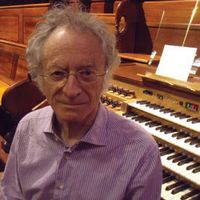
Robin Batterham
organ
Robin Batterham is assistant organist at Scots Church Melbourne where his activities include recitals, service playing, choir accompaniment and continuo work. He is also one of the country's leading scientists and engineers. He served as Chief Scientist of Australia from 1999 to 2005.

Marcel Dupré
composer
Marcel Dupré wrote organ music of high technical demand and clear liturgical purpose, from the fourteen meditations of Le Chemin de la Croix to the inventive Variations sur un Noël and Handel-based concertos still used in recital.
Digital booklet
Digital booklet Notes, texts and credits — read online or download the PDF Download the PDFPerformers
- Robin Batterham · organ
Technical credits
-
Recording Engineer
Martin Wright
-
Editing Engineer
Rhys Boak
Vaughan McAlley
-
Mastering Engineer
Martin Wright
-
Venue
The Scots' Church, Melbourne
-
Thanks to
Douglas Lawrence
-
Cover illustration
Benjamin Thomas
Details
- List price
- $25.00 AUD
- Total playing time
- 60 minutes 6 seconds
- Release date
- 2009
- Categories
- Classical, Organ
- Genres
- Organ, Choral & Sacred
- Musical work copyright
- © 2009 Move Records
- Sound recording copyright
- ℗ 2009 Move Records
- Catalogue
- MD 3332
- EAN
- 9314574333220
More to explore

North of the Yarra: Organs of Melbourne
Gordon Atkinson plays seven of Melbourne's finest organs, from the oldest surviving city instrument to the giant Town Hall organ, including St Patrick's Cathedral, The Scots' Church, St Paul's Cathedral and St Mary Star of the Sea, West Melbourne.

Transcriptions Baroque
Recorded in Trinity College Chapel, Melbourne, this disc pairs trumpeter Anthony Pope with organist Dominic Perissinotto across eight Baroque concertos. Four are heard on trumpet with organ accompaniment; the rest are solo organ transcriptions by celebrated organists of their day.