Gerald English
Gerald English (1925–2019) enjoyed a long career as a tenor in operatic and concert repertoire, as a recording artist and as an academic. He gave premiere performances of major twentieth-century works, often under the composers’ own direction, and forged close ties with Stravinsky, Henze, Britten, Tippett and Ford.
A founding member of the Deller Consort, Gerald brought long experience of Elizabethan music to a career that also took in Glyndebourne, the Royal Opera at Covent Garden, La Scala, and stages in Sydney, Adelaide, Manchester, Edinburgh, Florence, Rome, Paris and Buenos Aires. Premiere performances include Britten’s Nocturne with Sir John Barbirolli and the Hallé Orchestra, Henze’s We Come to the River directed by the composer at Covent Garden, Dallapiccola’s Ulisse conducted by the composer in Rome, and Berio’s Opera for the Florence Festival. He also premiered all of Andrew Ford’s works for tenor.
In 1978 he settled in Australia. For his first decade here he directed opera studies at the Victorian College of the Arts in Melbourne and supervised postgraduate work in baroque music and movement.
Later highlights include Janáček’s The Diary of One Who Disappeared at the 1992 Melbourne International Festival, the premiere of Andrew Ford’s Harbour with the Australian Chamber Orchestra in the same year, the storyteller in Peter Tahourdin’s Héloïse and Abelard for West Australian Opera, Ravel’s Chansons madécasses with the Australia Ensemble, Peggy Glanville-Hicks’ Letters from Morocco with the Hunter Orchestra and the Tasmanian Symphony Orchestra, and scenes from Ligeti’s Le Grand Macabre with the Melbourne Symphony Orchestra.
In 1993 he received an Australian Creative Artists’ Fellowship. His many recordings include the complete works of Monteverdi for HMV. In 1994 came his first solo disc since the 1970s — and the first classical recital he had ever recorded — Schumann Lieder (TP023). Further projects include Andrew Ford’s Whispers (TP053) and songs of Peggy Glanville-Hicks (TP074). With Il Pastor Fido he recorded cantatas by Telemann, Handel and Bach (Music, Love and Passion, MD 3152 — unreleased).
On What if a Day or a Month or a Year he is accompanied by Sharyn and Jonathan Rubin. Both were born in Sydney and have performed widely since meeting at the Schola Cantorum Basiliensis in 1976. As continuo players they have been associated with leading historical performances of baroque opera; Sharyn has worked with William Christie, Michael Corboz and Helmut Müller-Bräuth, and Jonathan appears on some twenty discs with Nikolaus Harnoncourt, Jean-Claude Malgoire, Michael Corboz and William Christie. They have taught in Australia, Hong Kong, Israel, Switzerland, France and Germany, and Jonathan has been lute teacher at the Geneva Conservatorium of Music since 1979.
Gerald English is featured on the following titles
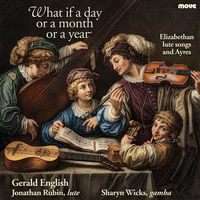
What if a Day or a Month or a Year
Elizabethan lute songs and Ayres sung by Gerald English, a founding member of the Deller Consort, with Jonathan Rubin on lute and Sharyn Wicks on gamba.
Performing as Victorian Time Machine
More about Victorian Time Machine
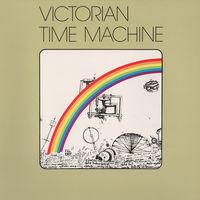
Victorian Time Machine
The Victorian Time Machine, directed by Richard David Hames, grew out of the Victorian College of the Arts as an instrumental and vocal ensemble for new music. This 1979 programme pairs Guillaume Dufay with works by Hames, Barry Conyngham and James Fulkerson.
director, early music consort