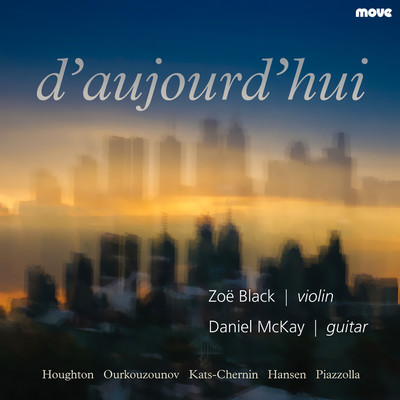
Listen & tracks
2 of 19 tracks have a preview · 5 works · 59:02
-
Sonatina BulgaricaAtanas Ourkouzounov 3 movements9:21
- 1 Allegro Ritmico 3:09
- 2 Largo 3:26
- 3 Vivo con Fuoco 2:46
-
Two Night MovementsPhillip Houghton 2 movements9:07
- 4 Full Moon 5:47
- 5 Banshee 3:20
-
Character InterludesElena Kats-Chernin 9 movements13:27
- 6 Character Interlude 1 1:14
- 7 Character Interlude 2 1:40
- 8 Character Interlude 3 1:09
- 9 Character Interlude 4 1:56
- 10 Character Interlude 5 1:19
- 11 Character Interlude 6 1:41
- 12 Character Interlude 7 1:39
- 13 Character Interlude 8 1:29
- 14 Character Interlude 9 1:20
-
Histoire du TangoAstor Piazzolla 4 movements20:01
- 15 Bordel 1900 3:51
- 16 Café 1930 7:10
- 17 Nightclub 1960 5:57
- 18 Concert d’aujourd’hui 3:03
-
19 Earwig Tim Hansen 7:06
Given the contemporary repertoire, and that two works receive premiere recordings, it seems apt to borrow the title from Piazzolla’s concert-hall tango ‘of today’, Concert d’aujourd’hui.
With the obvious exception of Piazzolla, the whirlwind tour through Europe, Argentina and Australia heard on d’aujourd’hui is provided by some of Europe and Australia’s most exciting living composers.
In the artist’s words
In composing Two Night Movements it was my intention to try to express feelings and emotions that night brings. During one magical, hot, windy summer evening at Christmas Hills, a sleepy hollow amongst rolling hills near Melbourne, in the middle of the bush and under stars clear and brilliant, themes of Full Moon surfaced. In the night I heard the faint stirrings of nocturnal creatures and trees rustling, while the opal glow of the full moon shone, reigning over all. As the piece evolved, I imagined magical specters and apparitions dancing and flying through clouds – friendly, yet a little unsettling and strange – and their dance was of yearning, love, hope and wonderment. On the other hand the second movement, Banshee, depicts a wild spirit of the night. A gypsy, its dance is boisterous and swift, almost demented. Its cheekily threatening nature gives way, towards the end, to a passionate, plaintive song before returning once again to its reckless flight and screeching end.
I decided to write a collection of pieces that would give them choices, i.e. they would not have to do each one. I tried to write as varied pieces as possible and each would last about a minute and a half long. Some movements are quite minimal and based on just a few notes and some are more like ragtime. Occasionally I used a motive from my previously composed pieces. The suite was written over a few weeks, and I was sending them to the players in bits. They were very patient with me. I am not a guitar player, I was grateful that Tim generously helped me with the guitar figurations and he re-configured the textures of some sections to make the writing more idiomatic. The 9 pieces can be played in any order, but the way they are numbered is the order in which they were written.
In 2005, when I was still an impoverished uni student, I was lucky enough to be able to attend the Darwin International Guitar Festival. Until then, I had never even considered writing for guitar, but after two weeks in the company of hundreds of these wonderful instruments and their owners, I was hooked. Since then I have moved on to become an impoverished composer, and have written a number of very different works for guitar.
Earwig was written in early 2006 not long after my return from the Festival, however it started out life as a piece for guitar and percussion. In my experience, a piece isn’t truly ‘finished’ until the performers get their hands on it, and as such, Earwig has gone through several different incarnations over the years. Here, for the first time, a violin replaces the percussion. It was a great challenge to find a way to keep the quirky flavour of the piece intact while still making use of the new timbres afforded by the violin. As such, the piece is now much more earthy than previous incarnations – woodblocks and triangles are replaced by tongue clicks and knuckle-taps, bright, brittle marimba passages with darker gypsy-inspired melodies, and overall the piece has a much more melancholy lyricism in the hands of Daniel and Zoë.
Reviews
It’s been a while since this CD was released. Finally I’ve had a chance to listen to and review it. It was definitely worth the wait; this recording deserved much more attention back in 2008 than it seems to have received.
Like every Move record I’ve had the chance to listen to, this is beautifully recorded. The competing demands of violin and guitar on the audio engineers cannot be overstated. The subtleties both of these instruments are able to attain, especially in the hands of such skilled players, can be hard to capture. This recording manages to do this while paying full respect to the louder presence of the violin in particular. The balance is very pleasing. All recordings should be this competent. The selection of fine Australian works on the CD is very satisfying. It is worth noting that both of the works by overseas composers, Ourkouzounov and Piazzolla, are treated with deep understanding and sympathy by Black and McKay. The driving Bulgarian rhythms, the microtonal inflections, the taut tango rhythms and the searing lyricism are all there.
The Australian works are treated with similar care. Kats-Chernin’s Character Interludes is a collection of idiosyncratic miniatures, a form in which she excels. The contrasting colours and textures of each movement are deftly handled by the performers. There is also a relaxation of the textures built up by the former works by Ourkouzounov and Houghton, which refreshes the ear. They fit very comfortably in the programme between the denser works and provide a steady centrepiece.
A Phillip Houghton guitar piece is always eagerly anticipated – at least by me, but I’ve a feeling I’m not alone! Two Night Movements is full of glorious colours – the sort of guitar writing that I would expect of Houghton. This work covers probably the widest expressive palette of any of the works on the recording. There are incredibly delicate sounds here which are very sweet to the ear. Again the performers are up to the challenge of the contrasting lyrical and rhythmic sections of the work, and Houghton’s piece, now over 20 years old, sounds fresh and spirited.
Tim Hansen, a composer who has a dual career in music and theatre, re-wrote Earwig for violin and guitar, after it had started life as a guitar and percussion piece. The sounds of tongue clicks, knuckle-taps, and some re-written melodies replace the original percussion. The resulting piece is very satisfying from a dramatic point of view; in particular my ear was drawn to sudden changes of colour and style, and unexpected silences.
This is a CD I’ve been delighted to hear at last. I recommend you take the chance to hear it too.
a whirlwind tour through Europe, Argentina and Australia and a really refreshing experience!
Artists
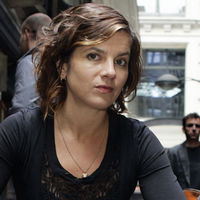
Zoë Black
violin
Zoë Black has won numerous awards including the National Youth Concerto Competition in 1989 and the String section of the ABC Young Performers Award in 1991.
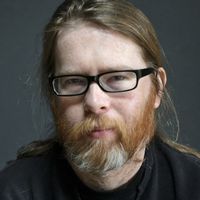
Daniel McKay
guitar
Daniel McKay began his musical studies at an early age under the guidance of his parents, both of whom are practicing music teachers. Daniel was active as a multi-instrumentalist, performing within a myriad of popular styles.
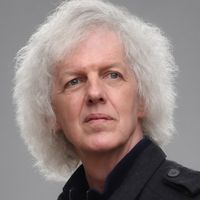
Phillip Houghton
composer
Phillip Houghton’s guitar music has been performed and recorded by leading musicians, including John Williams and Timothy Kain. A self-taught composer, he drew on classical, jazz, rock, ambient and world music.

Elena Kats-Chernin
composer
Elena Kats-Chernin AO (born 1957) is an Australian composer whose piano rags, chamber miniatures, ballet and stage scores have become central to contemporary Australian repertoire.
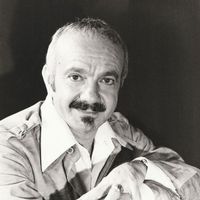
Astor Piazzolla
composer
Astor Piazzolla turned the tango into something sharper, more restless and chamber-like. His nuevo tango draws jazz harmony and classical counterpoint into the dance without blunting its edge.

Tim Hansen
composer
Tim Hansen is an Australian composer with a dual career in music and theatre.
Atanas Ourkouzounov
composer
Atanas Ourkouzounov is a Bulgarian composer whose guitar writing draws on folk rhythm, dance energy and a contemporary classical language. His work is heard on Australian recordings of recent chamber and duo repertoire.
Digital booklet
Digital booklet Notes, texts and credits — read online or download the PDF Download the PDFPerformers
- Zoë Black · violin
- Daniel McKay · guitar
Technical credits
-
Recording Engineer
Blake Stickland
Martin Wright
Vaughan McAlley
-
Venue
Move Records Studio
-
Credit
Stephen McKenzie
Details
- List price
- $25.00 AUD
- Total playing time
- 59 minutes 2 seconds
- Release date
- 5 Aug 2008
- Category
- Classical
- Musical work copyright
- © 2008 Move Records
- Sound recording copyright
- ℗ 2008 Move Records
- Catalogue
- MD 3323
- EAN
- 9314574332322
More to explore
Fluid Lines
After nearly a decade of hanging out, talking shop and drinking coffee, virtuoso guitarists Daniel McKay and Antony Field formed Duo 19. Their debut presents an eclectic programme of twentieth- and twenty-first-century works, including music by Australians Nigel Westlake and Phillip Houghton.
Ambient Voice
Ambient Voice places Dean Frenkel’s haunting harmonic vocals over and within works by outstanding Australian composers, among them Mark Clement Pollard, George Dreyfus, Andrew MacGregor and Invention in Time.
A Handful of Rain
Inspired by Javanese gamelan and Japanese Shinto music, Mark Clement Pollard's ambient concert works pursue beauty and simplicity. A Handful of Rain gathers this acclaimed Australian composer's popular style from the mid-1990s.
Crossing Paths
Ensemble Liaison and the Tony Gould Trio take turns across the programme: each piece is heard first in a scored reading, then in an improvised jazz response that opens the same melodic and harmonic material to fresh colour.
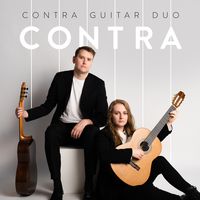
Contra
Contra Guitar Duo’s debut recording presents the lyricism, complex rubato and colour the pair most enjoy in two-guitar playing, across a short programme of romantic and contemporary works.
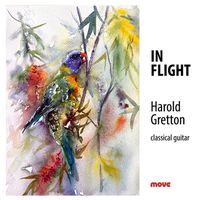
In Flight
Classical guitarist Harold Gretton offers a varied programme spanning some three centuries of solo guitar music, from Sylvius Leopold Weiß in the eighteenth century to his own Australian bird-inspired pieces of the twenty-first.