Listen & tracks
2 of 16 tracks have a preview · 2 works · 79:25
-
InfernoElliott Gyger 15 movements54:42
- 1 Prelude: The Gates of Hell 3:18
- 2 Interlude I: Acheron (the river of water) :58
- 3 Etude I: The First Circle (Limbo – the unbaptised) 4:34
- 4 Etude II: The Second Circle (the lustful) 4:05
- 5 Etude III: The Third Circle (the gluttonous) 1:20
- 6 Etude IV: The Fourth Circle (the miserly and the prodigal) 3:59
- 7 Interlude II: Styx (the river of mud) :51
- 8 Etude V: The Fifth Circle (the wrathful and the slothful) 5:46
- 9 Etude VI: The Sixth Circle (the heretics) 2:26
- 10 Interlude III: Phlegethon (the river of boiling blood) :47
- 11 Etude VII: The Seventh Circle (the three rings of violence) 4:14
- 12 Etude VIII: The Eighth Circle (the ten trenches of fraud) 11:09
- 13 Etude IX: The Ninth Circle (the traitors) 6:36
- 14 Interlude IV: Cocytus (the river of ice) :54
- 15 Postlude: the stars 3:45
-
16 Compass Variations Elliott Gyger (Variations I to XI) 24:43
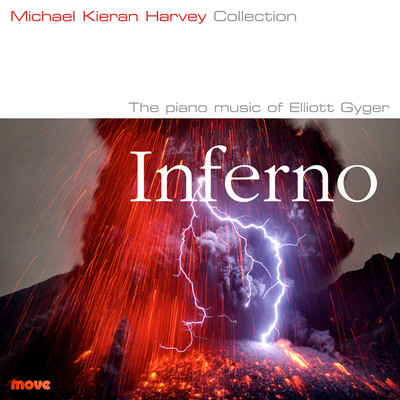
Inferno (2013) is an hour-long cycle for solo piano written for Michael Kieran Harvey. Powerful images from Dante’s vision of Hell provide programmatic starting-points for pieces whose internal logic is nonetheless purely musical. The vocabulary imprisons powerfully expressive gestures within tightly controlled structures, creating Lisztean tableaux of virtuosity and damnation influenced by Messiaen, Carter, Ligeti, Birtwistle and other giants of the post-war avant-garde.
The cycle consists of nine Etudes for the nine Circles of Hell, framed by four brief Interludes corresponding to the Rivers of Hell, together with a Prelude and Postlude. Each Etude explores a different subset of the piano’s range, moving gradually downward and alternately expanding and contracting across the cycle. All four Interludes traverse the same harmonic field spanning the entire range of the instrument, as well as the same metrical structure. Another recurring element is the transposition of Dante’s distinctive terza rima (three-line stanzas with interlocking end-rhymes: aba bcb cdc …) onto musical parameters.
Compass Variations (1993) was written for Simon Docking. In navigational terminology, the “variation of the compass” is the difference between true North and magnetic North. As one travels large distances across the world, this discrepancy varies continuously, from zero to a maximum of 180° at certain places in the Arctic and Antarctic.
The idea of gradual change, of the successive divergence and convergence of the compass needle on true North, is mirrored in the large-scale shape of Compass Variations in several ways: the lengths of sections alternately contract and expand, and the density of texture fluctuates between simple and complex. The tempo structure – starting at a moderate tempo and moving outwards to the extremes, so that the last two sections are the slowest and fastest respectively – could also be likened to a wildly swinging compass needle.
The two words in the title also have more specifically musical connotations. There is a long tradition of variation sets for keyboard, from the Fitzwilliam Virginal Book onward. Like other twentieth-century examples of the form (notably the key masterpieces by Webern and Copland), this work explores different ways of using the piano, rather than primarily variations on a theme.
Compass Variations focuses on two characteristics unique to the piano. Firstly, it exploits the whole of the instrument’s 88-note range (or “compass”), using the extreme high and low registers not merely for colour but as an integral part of the musical fabric. At some points a single melodic line spans several octaves, with huge leaps from one note to the next – a melodic style of which no other instrument is capable. Secondly, each of the work’s eleven variations calls for a different style of “touch”, that elusive quality so central to the art of playing the piano. While the musical material is stylistically consistent, the manner of playing ranges widely, “encompassing” keyboard styles from Bach and Chopin, through Liszt and Scriabin, to Webern, Prokofiev, Takemitsu and Boulez.
In the artist’s words
Ever since I heard the extraordinary performance by Simon Docking of Elliott Gyger’s Compass Variations on CD back in 1994 I have been wanting to release an album of Gyger’s unique piano music. It was only in 2009 that I finally had a chance to perform this particular amazing work, but recording technology has only recently become sufficiently advanced to remove the irritating helicopter noise from this live recording from the Landmarks series at Melba Hall, and so allow a CD release.
This makes a great complement to the gift of his 2013 piano cycle Inferno, which I premiered at the Totally Huge New Music Festival in Perth in August of that year. These two works bookend Elliott’s extraordinary musical universe – which, like Messiaen, appeared fully-formed at a precocious age, to extend in profundity and depth throughout an already long and stellar career.
Reviews
'Inferno' is a divinely demanding work executed by a masterful interpreter of state-of-the-art piano music. Such an uncompromising compositional approach has the potential to deter some audiences, however both the force of Dante’s imagery and the sheer boldness of the playing compel all ye who enter here.
Michael Kieran Harvey is a formidable presence in Australia's new music scene. An outspoken advocate for homegrown musical fare, he has championed the works of composers such as Carl Vine. His crusade continues with these two solo piano works by Elliott Gyger. Sydney-born but Melbourne-based, Gyger has earned an impressive list of accolades, including most recently the Sydney Symphony 80th Anniversary Composition Prize. The title track is the monumental Inferno (2013), named for the first part of the Divine Comedy. Gyger re-imagines Dante's depiction of hell and its creatively conceived punishments, using his own dramatic and variegated musical language. Rivers of blood and ice, hail and snow beating relentlessly against doomed sinners, ferocious winds and forests of harpies provide the impetus for this 15-movement work of devilish difficulty. Navigating the nine circles of Hell (plus four rivers) in just under an hour, the music culminates in a beautifully serene depiction of the starry night sky. Compass Variations (1993) follows, a compelling work exploring concepts of direction, and orientation. Gyger's music is imaginative and brilliantly conceived, and Kieran Harvey's performances are flawless. Nevertheless, this is indispensable for minds ready to take the plunge into a fascinating sound world. ★★★★
Artists

Elliott Gyger
composer
Elliott Gyger was born in Sydney, and has been writing music since about the age of ten. His compositional and research interests include the creation of a purely musical sense of drama and narrative, and the multilayered interplay of music and text.

Michael Kieran Harvey
piano
Australian pianist and composer Dr Michael Kieran Harvey FAHA is among the foremost interpreters of contemporary piano music of his generation. A champion of Australian music, he regularly commissions new work and has performed with the country’s leading contemporary ensembles and orchestras.
Digital booklet
Digital booklet Notes, texts and credits — read online or download the PDF Download the PDFPerformers
- Michael Kieran Harvey · piano
Technical credits
-
Recording Engineer
Blake Stickland
Martin Wright
Vaughan McAlley
-
Editing Engineer
Blake Stickland
-
Mastering Engineer
Martin Wright
-
Venue
Melba Hall
Move Records Studio
-
Cover photo
Martin Rietze
-
Michael Kieran Harvey photo
Pia Johnson
Details
- List price
- $25.00 AUD
- Total playing time
- 79 minutes 25 seconds
- Release date
- 2014
- Categories
- Australian, Classical
- Musical work copyright
- © 2014 Move Records
- Sound recording copyright
- ℗ 2014 Move Records
- Catalogue
- MD 3376
- EAN
- 9314574337624
More to explore
De Tribus Impostoribus
This is a new collection of works by acclaimed Australian pianist and composer Michael Kieran Harvey, bringing together music spanning more than two decades of his distinctive and adventurous creative practice.
The life in between
Michael Kieran Harvey anchors this solo piano programme with Martin Friedel’s final work, …the life in between…, then sets it among virtuoso scores by Pertout, Crossman, Spiers, Selleck and McAlley.
War Sonatas
Three piano sonatas by Michael Kieran Harvey, written as a response to twenty-first-century war. Spoken poems by Arjun von Caemmerer stand between the works, framing a triptych of anger, friendship and warning.
Threnody
Michael Kieran Harvey’s landmark 1995 Astra recital of late twentieth-century Australian piano music returns in a 2024 Move re-master. Premiere recordings by Harvey, Vine, Campbell, McCaughey, Byrne, Humble and Anderson form one continuous programme.
The Sparrow and the Mead Hall
Composed and mostly performed by Michael Kieran Harvey, these 2021 works move from the rarefied extended techniques of Piano Sonata #7 and Liszt–Busoni bravura in the Four Ballades to bebop wit in Lawyers… and metal-edged satire in Death Cap Mushroom.
Shichiseki
Collaborations with violinist Miwako Abe and cellist Alister Barker sit beside solos written for Michael Kieran Harvey by Gabriella Vici and Andrián Pertout, spanning Japanese, Latin American and South Indian influences.