Listen & tracks
3 of 13 tracks have a preview · 5 works · 74:41
-
Fantaisie-Sonata (1999)Michael Bertram 3 movements48:40
- 1 First movement 20:44
- 2 Second movement 13:46
- 3 Third movement 14:10
-
4 Six Bagatelles (2012) Michael Bertram #2 Chant 4:52
-
5 Violet 2 Michael Bertram 4:49
-
6 Six Bagatelles (2012) Michael Bertram #5 Uranus 3:50
-
Seven Sarcasms for an Out-Of-Tune Piano (2010/2013)Michael Bertram 7 movements12:30
- 7 i. 2:19
- 8 ii. 2:13
- 9 iii. 2:04
- 10 iv. 1:43
- 11 v. 1:46
- 12 vi. 1:16
- 13 vii. 1:09
Larry Sitsky went on to call the Fantaisie-Sonata a ‘massively ambitious work on a grand romantic scale’, with a self-belief that reminded him of Scriabin. ‘I have a feeling that the composer has something to say and is not afraid to say it in the face of current fashions, which I find admirable.’
The shorter pieces offer contrast, ending with the iconoclastic Seven Sarcasms for an Out-of-Tune Piano.
Harvey gave the premiere of Fantaisie-Sonata in 2001. Clive O’Connell, writing in The Age, noted that he ‘performed with involvement and intensity, outlining the work’s characteristics in broad strokes, observing every change of texture and emotion. The sonata takes full advantage of its fantasy nomenclature … the effect is an elongated improvisation which Bertram has couched in a variety of languages.’
In the artist’s words
The sonata is in three movements. Each movement is built around a literary text and represents a journey. Through a Celtic phantasmagoria / from innocence to disillusion / and finally through darkness to light.
First movement:
“And then lost Niamh murmured, ‘Love we go to the Island of Forgetfulness, and lo! The Islands of Dancing and of Victories are empty of all power’ ‘And which of these is the Island of Content?’ ‘None know’ she said.”
The overall plan is an arch with a g sharp–g natural motif. Within this arch are a number of tone-rows and other episodic material. A secondary theme (employing the same motif) slowly builds to an avowedly romantic climax.
Second movement:
“We have an interval and then our place knows us no more”
A set of seven variations on the theme a-b-c-d, portraying a progression from ingenuousness to the dissolving of dreams. As befits a ‘life story’, some of the music is intentionally prosaic.
Third movement:
“… Man, in imitation of his Creator, … wanted to reproduce the continuity of Cosmic Time …”
A contrast between ‘darkness’ and ‘light’. The former is represented by an extended series of ‘synthetic’ scales which slowly transmogrify; the latter by ever mounting sequences of repeated notes and chords which ultimately recede into the infinite.
The last bars of this movement are marked ‘Like the beating of Angels’ wings’.
Six Bagatelles (2012) #2 Chant
A modest extemporisation on a long remembered folk song fragment. With just four notes this simple melody seems to sum up that particular Russian feeling for melancholy which I find very appealing.
Violet 2
The second of two ‘Violet’ pieces I have written, both of which depict the same journey, a very real and personal journey which commenced in some hope but finished in anguish. The harshness of the climax is an attempt to convey not anger but the powerlessness I felt at the time.
Six Bagatelles (2012) #5 Uranus
A glimpse of what it might perhaps be like in the cold, silent and forbidding world of the planet Uranus and its five moons. Brian Eno is the inspiration here.
Seven Sarcasms for an Out-Of-Tune Piano (2010/2013)
A suite of tongue-in-cheek retro pieces for (if needs be) an out-of-tune piano.
Along the way I find room for brief references to composers with whom I feel some affinity such as Satie, Messiaen, Webern and Hindemith. Also tucked away inside are glimpses of favourites of mine from the past such as ‘The Ash Grove’ and the German carol ‘es ist ein ros entsprungen’.
The Sarcasms conclude with an out of left field two-note ‘doorbell motif’ in A major.
Reviews
It’s not a form you come across too often, the fantasy-sonata combination. There are the two by Scriabin – an early one outside the canon and the Op. 19 in G sharp minor (there’s a lovely key for you) – one by Raff, another by Turina. Only the German composer uses the same title word-order as Bertram; not that it would make too much difference, I suppose, except in giving some hint about the composer’s set of priorities. The Australian work is a confronting amalgam that has a great freedom in its opening, then becomes more formally conservative as it moves towards its ending.
The Fantaisie-Sonata is this CD’s major offering, coming in at a little under 50 minutes. In comparison, the other compositions are slighter: two of the Six Bagatelles from 2012, the Seven Sarcasms for an Out-Of-Tune Piano, and an isolated Violet 2, written five years ago. None of these cracks the five-minute mark, the Sarcasms cycle’s elements decreasing in time-span as the work moves to its conclusion. But, as a job lot, these comprise a substantial amount of the composer’s output for solo piano. Still, the oldest piece is the CD’s title work which has waited 16 years for its appearance here, performed by its initial interpreter with splendid technical mastery and obvious sympathy...For its breadth – of intellectual ambition, of pianistic skill, of emotional flexibility, of sustained continuity – this is an extraordinary construct, Harvey giving it as eloquent an interpretation as you could want. What I find particularly attractive about it is that it maintains your attention; it excites, puzzles, illuminates in turn and what sense you make of its language, form and imaginative processes depends on a willingness to enter Bertram’s idiosyncratic but remarkably open sound-world...For all that, Move has done us all excellent service by giving a voice to this impressive, challenging composer and providing a forum once again for the insights and artistry of this country’s finest pianist.
Michael Kieran Harvey’s excellent track record in championing the piano music of Australian composers is evidenced again in this compelling interpretation of Michael Bertram’s impressive major piano work, Fantaisie-Sonata. Bertram’s flamboyant approach to piano composition is ideally suited to the virtuosic brilliance of Harvey’s pianism. In a way the smaller works filling out the CD are as worthy of attention and promotion as Bertram’s major piano work, Fantaisie-Sonata. Michael Kieran Harvey certainly gives them the interpretive respect they deserve.
Artists

Michael Bertram
composer
Michael Bertram's early musical experience was in a cathedral choir, and later as a pianist. He started composing in the 1970s.

Michael Kieran Harvey
piano
Australian pianist and composer Dr Michael Kieran Harvey FAHA is among the foremost interpreters of contemporary piano music of his generation. A champion of Australian music, he regularly commissions new work and has performed with the country’s leading contemporary ensembles and orchestras.
Digital booklet
Digital booklet Notes, texts and credits — read online or download the PDF Download the PDFPerformers
- Michael Kieran Harvey · piano
Technical credits
-
Recording Engineer
Blake Stickland
Vaughan McAlley
-
Mastering Engineer
Martin Wright
-
Venue
Move Records Studio
-
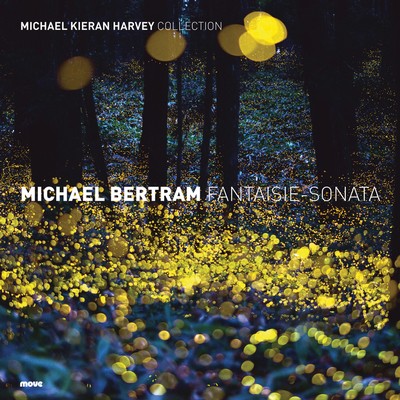
Cover image
Tsuneaki Hiramatsu
Details
- List price
- $25.00 AUD
- Total playing time
- 74 minutes 41 seconds
- Release date
- Mar 2016
- Categories
- Australian, Classical
- Musical work copyright
- © 2016 Move Records
- Sound recording copyright
- ℗ 2016 Move Records
- Catalogue
- MD 3407
- EAN
- 9314574340723
More to explore
De Tribus Impostoribus
This is a new collection of works by acclaimed Australian pianist and composer Michael Kieran Harvey, bringing together music spanning more than two decades of his distinctive and adventurous creative practice.
The life in between
Michael Kieran Harvey anchors this solo piano programme with Martin Friedel’s final work, …the life in between…, then sets it among virtuoso scores by Pertout, Crossman, Spiers, Selleck and McAlley.
War Sonatas
Three piano sonatas by Michael Kieran Harvey, written as a response to twenty-first-century war. Spoken poems by Arjun von Caemmerer stand between the works, framing a triptych of anger, friendship and warning.
Threnody
Michael Kieran Harvey’s landmark 1995 Astra recital of late twentieth-century Australian piano music returns in a 2024 Move re-master. Premiere recordings by Harvey, Vine, Campbell, McCaughey, Byrne, Humble and Anderson form one continuous programme.
The Sparrow and the Mead Hall
Composed and mostly performed by Michael Kieran Harvey, these 2021 works move from the rarefied extended techniques of Piano Sonata #7 and Liszt–Busoni bravura in the Four Ballades to bebop wit in Lawyers… and metal-edged satire in Death Cap Mushroom.
Shichiseki
Collaborations with violinist Miwako Abe and cellist Alister Barker sit beside solos written for Michael Kieran Harvey by Gabriella Vici and Andrián Pertout, spanning Japanese, Latin American and South Indian influences.