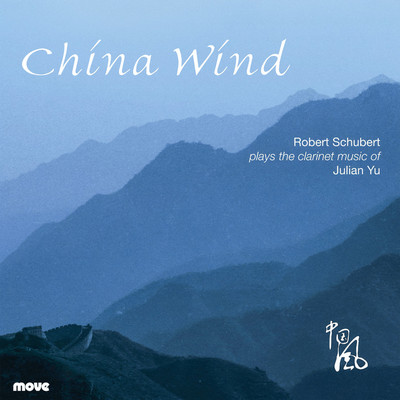
Listen & tracks
4 of 9 tracks have a preview · 5 works · 61:35
-
Concerto on Chinese ThemesJulian Yu 3 movements20:22
- 1 Moderato 10:56
- 2 Lento 3:42
- 3 Vivace 5:44
-
4 The Lamentation of Micius Julian Yu 9:56
-
5 Atanos Julian Yu 15:14
-
6 Sol Do La Re Julian Yu 5:32
-
Silent and AloneJulian Yu 3 movements10:31
- 7 Since We Parted 3:28
- 8 Silent and Alone 3:12
- 9 Lingering Thoughts 3:51
The playing from clarinettist Robert Schubert and his collaborators is exceptionally fine. High-fidelity tone-colour and sound quality capture rich ensemble textures across several Melbourne venues.
Julian Yu has long been fascinated by the organisation, discipline and formularisation of Western classical music. Those same qualities belong to Chinese folk music and can imply limitation, yet Yu builds from such foundations with great freedom. The music of Atanos is non-programmatic and follows its own inner laws.
Yu first wrote Sol Do La Re as a counterpoint exercise for string quartet while studying in Japan in 1985. While not strictly serialist, it rests on a twelve-tone ground bass arranged pentatonically and repeated ten times, above which the music unfolds with extraordinary beauty and intensity. In 1996 he made the version for clarinet and string trio heard here.
In 1997 Robert asked Yu for a new clarinet work, The Lamentation of Micius. As a student in Beijing Yu had encountered ancient music known as ‘Micius Laments the Silk’. The philosopher Micius had lamented pure silk dyed into many colours, likening that loss of innocence to what happens when people take on the colours of the world around them.
Raw material for the Concerto on Chinese Themes for Clarinet and String Orchestra comes from northern Chinese wind-and-percussion music: exuberant, memorable melodies, strident sonorities and striking rhythms.
Silent and Alone sets three poems by Li Yu (937–978), last emperor of the Southern Tang, who wrote that in prison he “washed his face with his tears every day”. First composed for tenor and orchestra, Yu’s version for clarinet, piano and string quartet is no mere transcription; it finds fresh nuances of timbre and expression.
The disc shows Yu’s versatility, emotional breadth and command of style and technique.
Reviews
This disc, with the accomplished clarinet playing of Schubert, is highly recommended ★★★★½
Julian Yu is one of Australia’s most illustrious composers, with an international reputation and a long list of awards to his name. This CD presents a selection of Yu’s music from several stages of his career, with the common thread being the clarinet, and more specifically, clarinettist Robert Schubert, a long-time champion of Yu’s music.
As a survey of chamber and orchestral works ranging from the 1980s to the early 2000s, this album serves as a good introduction to Yu’s work. The playing from Schubert and his collaborators is exceptionally fine, and the recordings made in several locations around Melbourne capture beautiful, rich sounds from the various ensembles. This high fidelity tone-colour and sound quality is of course what every composer hopes for, but is perhaps particularly important for Yu’s very “classic” music which seems to demand a certain consistency of sound in performance and reproduction. The earliest work represented here, Sol Do La Re, is a passacaglia study from the early 1980s. It’s a charming curiosity, and evidence of Yu’s longstanding mastery of the technical mechanisms of Western counterpoint.
Two more substantial works, Atanos and The Lamentation of Micius, date from a key period of Yu’s work, the 1990s. Here, we find the creative voice that made him famous, introducing what seemed to be a new kind of lyricism to late-20th century modernist concert music. Atanos (1995) is a very fine piece for clarinet, flute and string trio, inflected with a lovely warm chromaticism and references to the twilight romanticism of Zemlinsky, early Schoenberg and Berg.
The Lamentation of Micius (1997-8), on the other hand, takes inspiration from ancient Chinese Qin music. While not actually making direct use of the musical material of the original, the Chinese music suggested certain kinds of sonority to Yu. The result is a terrific ensemble piece for clarinet and string quartet, making particularly splendid use of pizzicato effects to create a beautiful sound-world that is somehow both abstract and poetic. With the three-movement Silent and Alone (2000), originally composed for voice and orchestra but here presented in an alternate version for clarinet and string quartet, we find Yu giving free reign to the frank romanticism that must have been an asset during his early career as a “ghost writer” for film and tv soundtracks. Here, the chromatically saturated diatonicism that was always latent in Yu’s concert music gives way to explicit tonality and an aesthetic that sounds strangely retro, complete with quaint oriental flourishes.
The most recent work on the CD, a Concerto on Chinese Themes for Clarinet and Orchestra (2004) takes this a big step further into the well-trodden genre of folksy Chinese-Western orchestral hybridity. Appropriating some well-known Chinese “folk” tunes, this concerto seems to hark back to some kind of naively ideological musical style. A nostalgia for the composer’s youth? A political message about the role of China in the modern world? Or perhaps a respectful homage to the pioneers of Chinese orchestral composition in the optimistic years of the old republic, who themselves used some of these same tunes? What this style of music means for the 21st century remains unclear. The Greek composer Iannis Xenakis noted that when transcribed into western notation Asian music loses its unique characteristics and sounds like western music. Yu’s concerto seems closer in spirit to early Vaughan-Williams than to anything particularly Asian, and perhaps that is the point.
Artists

Julian Yu
composer
Julian Yu is a multi-award-winning Australian composer whose musical language is imbued with elegance and expressiveness, both enhanced by impeccable craft and a special attention to detail.
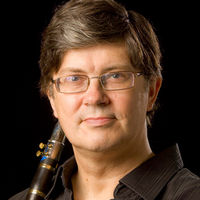
Robert Schubert
clarinet
Robert Schubert is a Melbourne clarinettist and woodwind lecturer whose playing centres on chamber music and new works written for him.
Digital booklet
Digital booklet Notes, texts and credits — read online or download the PDF Download the PDFPerformers
- Robert Schubert · clarinet
- Derek Jones · flute, piccolo · track 5
- Victorian College of the Arts Strings · ensemble · tracks 1–3
- Marco van Pagee · conductor · tracks 1–3
- Akemi Schubert · piano · tracks 7–9
- Isin Cakmakcioglu · violin · tracks 4–6
- Lorraine Hook · violin · tracks 7–9
- Deborah Goodall · violin · tracks 4, 5, 7–9
- Danielle Arcaro · viola · tracks 4–6
- Gabby Halloran · viola · tracks 7–9
- Rachel Atkinson · cello · tracks 4–6
- Virginia Kable · cello · tracks 7–9
Technical credits
-
Producer
Lydia Warren
-
Recording Engineer
Martin Wright
Peter Taplin
Robin Gray
Vaughan McAlley
-
Venue
Iwaki Auditorium, Melbourne
Monash University School of Music Auditorium
Move Records Studio
Details
- List price
- $25.00 AUD
- Total playing time
- 61 minutes 35 seconds
- Release date
- Oct 2012
- Category
- Classical
- Musical work copyright
- © 2012 Move Records
- Sound recording copyright
- ℗ 2012 Move Records
- Catalogue
- MD 3351
- EAN
- 9314574335125
More to explore

Old and Yu: The Clarinet Music of Julian Yu, Vol. 2
Catchy short pieces by Julian Yu for clarinet with string quartet, and with cello and piano: playful settings that braid Chinese folksong with oddly familiar classical themes, including Dvořák and Mozart.
Bach to China with Yu
Volume 3 of Julian Yu’s clarinet music, with Robert Schubert and ensemble in arrangements that join Chinese folk melody to Western classical craft.

50 Chinese Folk Songs
The first of two collections on this disc, 50 Chinese Folk Songs, presents Julian Yu’s piano arrangements of well-known Chinese melodies. Fifteen further early piano pieces mix song arrangements with original writing. All 65 tracks are played by Ke Lin.
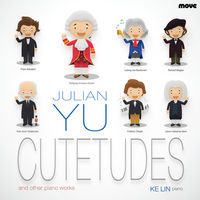
Cutetudes
Cutetudes (‘cute’ + ‘études’) is a set of twenty short, classically related and humorous piano pieces Julian Yu wrote on commission from pianist Ke Lin.
Reminiscences
This is Julian Yu's second collaboration Guangzhou Pearl River Symphony Orchestra, this time of orchestrations and arrangements of Chinese folk songs and musical excerpts.
Julian Yu 10 CD Collection
Ten Move CDs of Chinese-Australian composer Julian Yu, spanning chamber, piano and clarinet works written over decades, with Move 50 as a bonus disc.