Listen & tracks
2 of 7 tracks have a preview · 5 works · 74:46
-
The CrossingTony Gould 3 movements19:37
- 1 first movement 7:15
- 2 second movement 7:43
- 3 third movement 4:39
-
4 Menin Gate Helen Gifford 8:50
-
5 Folly Andrew Ford 12:56
-
6 Sonata for Piano Julian Yu 24:26
-
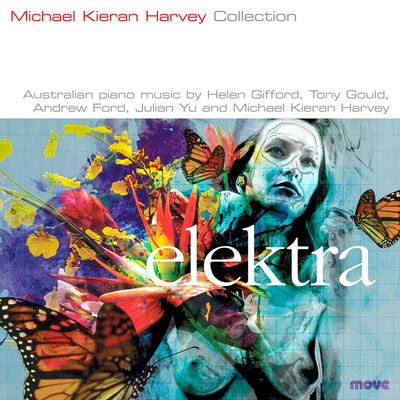
7 Elektra Michael Kieran Harvey 8:57
Gould’s three-movement The Crossing was written for Harvey and draws on jazz and classical models without empty display. Gifford’s Menin Gate mourns the missing of Ypres. Ford’s Folly builds new variations on the old La Folia ground, and Yu’s single-movement Sonata for Piano was commissioned at substantial length.
Across the programme the fixed design of the score meets the risk and spontaneity of live performance, from ferocious figuration to quiet lyricism and the early computer morphing of overtones in Elektra itself.
In the artist’s words
This work, our first collaboration, grew out of my interest in dealing with the question of computer versus human performance – since Asimov's vision of the revolution in robotics (and his memorable description of a future synthesised music recital in the Foundation series) and the preference of composers like Zappa for computers over live musicians – and led me to wonder what were the compelling aspects of the live performance versus the perfect execution achievable on the new computer instruments.
This conundrum has increased and will continue to do so with the prosthetic integration of robotics with biology (and humans). Indeed it is increasingly impossible to avoid chemical intervention within the human lifecycle, so enhancement is now a human evolutionary reality.
I had spent some time exploring the intersection between what a composer hears, then realises on the computer, and then what is humanly possible in live performance. Ives, Nancarrow, Ferneyhough, Stockhausen, Boulez and others had been pushing these boundaries well before the rise of the PC but the ease and complexity of computer-generated music for the piano now begs the question: what is the performer for? If the performer will only be able to execute the score with varying degrees of failure, what is the point in attempting it in the first place? Should the composer ignore his/her own creative desires and only write what is comfortable for the performer and audience?
It boils down to whether humans wish to listen to intelligent machines or other humans. The answer seems to be: it depends. The prosthetic integration of artificial intelligence with human intelligence is an increasing fact of life within art. One wonders though whether an intelligent machine would ever want to play or listen to music for its own satisfaction.
I came to realise that what I was looking for in live performance could be found in Australian improvising pianists like Grabowsky, Nock and Tony Gould. There is in Gould's music – an experimentation and absorption in the moment; naturally a refreshing spontaneity but also a humility that is totally unlike the more painful histrionics of his overseas colleagues. The sense of playful irony is clearly evident in the music of Ford and Yu, where ancient forms are reinvigorated with the energy of popular music. The dark aspect of human technological advancement through human slaughter is mourned in the Gifford work Menin Gate.
Each of the works on this CD I think strives to express the tension in music between formula and spontaneity.
Reviews
The latest collaboration between Move Records and the indefatigable master-pianist has Harvey performing works by four substantial Australian composers, three of the pieces commissioned especially for his volcanic talent. Taking pride of place are Tony Gould's three-part The Crossing, packed with the jazz expert's angular lyricism, and Julian Yu's sonata of 2005. Harvey also presents his engrossing reading of Andrew Ford's Folly, given to deserved acclaim in August's Piano! festival at the National Academy of Music, and Helen Gifford's striking Menin Gate. The CD concludes with its title-work, a highly challenging piano-plus-computer composition by Harvey himself.
Artists
Andrew Ford
composer
Andrew Ford is an Australian composer, writer and broadcaster whose work ranges from chamber and vocal scores to opera and piano cycles. He has won the Paul Lowin Prize for the song cycle Learning to Howl and a Green Room Award for the opera Rembrandt’s Wife.

Helen Gifford
composer
Helen Gifford OAM is an Australian composer whose music often draws on Balinese and Javanese elements. She writes for stage, orchestra, chamber ensemble and solo instruments.

Julian Yu
composer
Julian Yu is a multi-award-winning Australian composer whose musical language is imbued with elegance and expressiveness, both enhanced by impeccable craft and a special attention to detail.
Tony Gould
composer
Pianist and composer Tony Gould is one of Australia’s most respected musicians. His career has spanned jazz and other improvisatory forms as well as traditional and contemporary classical, and for decades he has stood at the forefront of music education in Australia.
Michael Kieran Harvey
piano
Australian pianist and composer Dr Michael Kieran Harvey FAHA is among the foremost interpreters of contemporary piano music of his generation. A champion of Australian music, he regularly commissions new work and has performed with the country’s leading contemporary ensembles and orchestras.
Digital booklet
Digital booklet Notes, texts and credits — read online or download the PDF Download the PDFPerformers
- Michael Kieran Harvey · piano
Technical credits
-
Recording Engineer
Martin Wright
Michael Hewes (track 7)
Vaughan McAlley
-
Editing Engineer
Vaughan McAlley
-
Mastering Engineer
Martin Wright
-
Venue
Move Records Studio
North Melbourne Elm Street Hall
-
Cover artwork
Benjamin Thomas
Details
- List price
- $25.00 AUD
- Total playing time
- 74 minutes 46 seconds
- Release date
- 13 Aug 2009
- Categories
- Australian, Classical, Keyboard
- Musical work copyright
- © 2009 Move Records
- Sound recording copyright
- ℗ 2009 Move Records
- Catalogue
- MD 3329
- EAN
- 9314574332926
More to explore
De Tribus Impostoribus
This is a new collection of works by acclaimed Australian pianist and composer Michael Kieran Harvey, bringing together music spanning more than two decades of his distinctive and adventurous creative practice.
Reminiscences
This is Julian Yu's second collaboration Guangzhou Pearl River Symphony Orchestra, this time of orchestrations and arrangements of Chinese folk songs and musical excerpts.
The life in between
Michael Kieran Harvey anchors this solo piano programme with Martin Friedel’s final work, …the life in between…, then sets it among virtuoso scores by Pertout, Crossman, Spiers, Selleck and McAlley.
The Other Side of Tony Gould
Tony Gould is best known as a jazz pianist and improviser. This recording turns to his classical side: original concert works written over two decades, with Stravinsky’s The Rite of Spring in a four-hand piano version.
Shifting Landscapes
Shifting Landscapes is Australian flautist Kathryn Moorhead’s survey of the flute’s contemporary sound world, gathering works that push the instrument past its familiar range through extended technique, colour, and texture.

Bach to China with Yu
Volume 3 of Julian Yu’s clarinet music, with Robert Schubert and ensemble in arrangements that join Chinese folk melody to Western classical craft.