Listen & tracks
4 of 14 tracks have a preview · 11 works · 73:11
-
1 A Birthday Vaughan McAlley for 5 voices 3:34
-
2 Madrigal Vaughan McAlley for 4 voices 1:57
-
3 To Rosamounde, a balade Vaughan McAlley for 8 and 18 voices 4:51
-
Four Chorale Preludes for PianoVaughan McAlley 4 movements15:25
- 4 Kyrie, Gott Vater in Ewigkeit 5:12
- 5 Allein Gott in der Höh’ sei Ehr’ 1:26
- 6 Heilig, heilig, heilig 2:32
- 7 O Lamm Gottes unschuldig 6:15
-
8 Lamentations Vaughan McAlley for 5 voices 11:54
-
9 String Quartet (2015) Vaughan McAlley iii. Lento 9:22
-
10 In principio erat verbum Vaughan McAlley for 5 voices 4:39
-
11 I will lift up my eyes unto the hills Vaughan McAlley for soprano and string quartet 5:22
-
12 Lord, you have been our dwelling place Vaughan McAlley for 5 voices 4:29
-
13 The Lord Bless You and Keep You Vaughan McAlley for recorder and 4 voices 2:55
-
14 Omnes angeli Vaughan McAlley for 40 voices 8:43
When not working as a sound engineer at Move Records, Vaughan McAlley is a singer and composer. His music is sonorous, and he likes to explore the expressive potential of counterpoint.
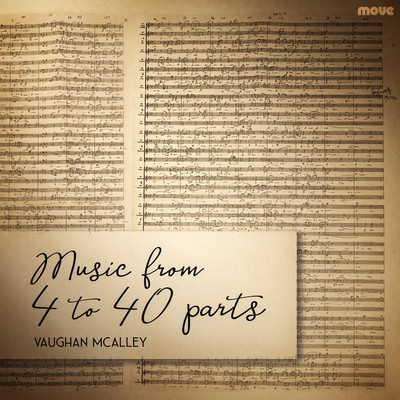
Music from 4 to 40 Parts gathers a representative sample of his compositions from 2001 to 2015. Performers include the Angeli Vocal Ensemble, pianist Michael Kieran Harvey, chamber choir Ensemble Gombert and the Four Seasons String Quartet.
His epic motet Omnes angeli may be the first fully polyphonic 40-part piece since Thomas Tallis wrote Spem in alium in 1570.
In the artist’s words
I have always been interested in counterpoint – the art of combining different, often contrasting, musical lines into a pleasing whole. While much music consists of a melody (“the tune”) and accompaniment, contrapuntal music can be more egalitarian, with the importance of each line ebbing and flowing throughout a piece. JS Bach, Mozart and Beethoven all recognised the expressive potential of counterpoint and made concerted efforts to improve their contrapuntal skills later in their composing careers.
The rules of renaissance counterpoint were enthusiastically adopted in the middle of the 15th century, and were used in art music for more than 150 years. They are very clear about which intervals are consonant and dissonant (sweet and harsh-sounding), and how dissonance can be used. I decided to adopt these rules in my own compositions at the age of 30.
There are three things about this style that make it well-suited to my music. First, the majority of the surviving art music from this period is vocal and choral music. I have sung in choirs for 30 years and have composed a great deal of choral music. Voices are ideal for articulating counterpoint because a composer can use the text to emphasise a line within a texture. Second, singers have more flexible tuning than most instruments, allowing chords to be tuned according to the rules of just intonation. Finally, the style is well-suited to composing music in a large number of parts. Musical developments after the year 1600 made composing music in more than about eight parts more difficult, and writing for a large number of distinct parts became a lost art. Thomas Tallis’ 40-part motet Spem in alium (c.1570) was almost incomprehensible to the musicians of Victorian England.
Music from 4 to 40 parts contains music in this “neo-renaissance” style, mainly for voices, but also for piano and for string quartet. My approach to counterpoint differentiates my music from most other contemporary compositions, and I strive to create music that is both satisfying for all performers involved and pleasing to listen to as a whole. I hope you enjoy listening!
Reviews
McAlley’s unfailing optimism for humanity is written into the fabric of his music. Compositions ranging from wedding gifts to his 40 part masterpiece are offered to performers and audience alike with a humility that only a truly gifted composer can convey. Deeply intelligent and cerebral, his works hide a treasure trove of meaning and references for those who wish to look. But this academic attention in no way compromises the sublime beauty of his works, ever immersive and uplifting.
To Rosamounde, a balade uses a Chaucer text, setting for 8 voices one of the poem’s three stanzas. This work, full-bodied in character and one of the disc’s most two monumental constructs, is performed by the Ensemble Gombert conducted by John O’Donnell and it brings back memories of that group’s richly rewarding recitals held at Xavier College Chapel for many years. The stanza octet is set lucidly with both the linear meshing and the interplay sensible, utilising compositional devices with admirable facility. McAlley has added an optional extra, a coda for 18 voices to the last line, Thogh ye to me ne do no daliaunce, which is suggestive of Monteverdi, the Gabrielis, and – of course – Tallis. At this multiphonic point, the words become meaningless because the vocal complex becomes an end in itself. The effect is sumptuous, the massive piling up of individual voices most impressive to aurally bathe in. For his 40th birthday, the composer proposed to organise a performance of the Tallis 40-part anthem Spem in alium . . . All 40 lines come together to excellent effect at the first Amen. For the motet’s second part, the texture is almost continuously massive so that the evangelist’s words of praise become a sonorous melange with a few thinner oases before the explosion which is a sort of extended vocal fantasia on a concluding Amen! Tallis wrote for eight 5-part bodies; McAlley for ten 4-part groups – but detecting the difference in weight would require finer ears than mine. I can hear some insecure voices in patches of the first half of Omnes angeli but these are soon forgotten when you’re faced with the sumptuous power of the work’s later pages which give a remarkable aural realization of angelic jubilation. . . . A tribute to the musical past by recreating it.
This unusual disc contains fourteen works composed between 2001 and 2015 by the Melbourne-based singer and sound engineer, Vaughan McAlley. Unusual, because he has used the rules of Renaissance counterpoint as the compositional technique for every work, so the overall impression is that the music is at least six centuries old!
Artists
Vaughan McAlley
composer
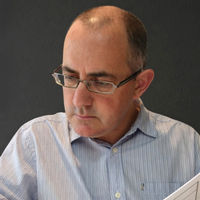
Vaughan McAlley is a composer and arranger, alto and tenor, a capable flautist and French horn player, and the recording engineer behind countless Move releases.
Digital booklet
Digital booklet Notes, texts and credits — read online or download the PDF Download the PDFPerformers
- Angeli Vocal Ensemble · singers · tracks 1, 2, 8, 10, 12 and 13
- Ensemble Gombert · choir · tracks 3 and 14
- Michael Kieran Harvey · piano · tracks 4–7
- Four Seasons String Quartet · strings · tracks 9 and 11
- John O'Donnell · conductor · tracks 3 and 14
Details
- List price
- $25.00 AUD
- Total playing time
- 73 minutes 11 seconds
- Release date
- 2 Aug 2019
- Categories
- Choral, Classical, Keyboard
- Musical work copyright
- © 2019 Vaughan McAlley
- Sound recording copyright
- ℗ 2019 Move Records
- Catalogue
- MD 3437
- EAN
- 9314574343724
More to explore
De Tribus Impostoribus
This is a new collection of works by acclaimed Australian pianist and composer Michael Kieran Harvey, bringing together music spanning more than two decades of his distinctive and adventurous creative practice.
Encores
Directed by Douglas Lawrence, the Australian Chamber Choir gathers favoured concert encores in a programme that shows the ensemble at its most immediate and engaging.
The life in between
Michael Kieran Harvey anchors this solo piano programme with Martin Friedel’s final work, …the life in between…, then sets it among virtuoso scores by Pertout, Crossman, Spiers, Selleck and McAlley.
The Well-Tempered Clavier: Books 1 and 2
Distinguished Australian pianist and harpsichordist Judith Lambden presents J.S. Bach’s complete Well-Tempered Clavier, Books I and II (BWV 846–893), recorded across nine years as a five-CD set.

My Heart
Naarm/Melbourne pianist Danaë Killian presents an expressionist programme of solo piano, spoken word and tarot, centred on her own My Prussian Blue Heart and works by mostly Australian composers.
Shifting Landscapes
Shifting Landscapes is Australian flautist Kathryn Moorhead’s survey of the flute’s contemporary sound world, gathering works that push the instrument past its familiar range through extended technique, colour, and texture.