Listen & tracks
1 of 21 tracks have a preview · 21 works · 56:54
-
1 An die Freude, KV 53/47e Wolfgang Amadeus Mozart 3:24
-
2 "Wie unglücklich bin ich nit" KV 147/125g Wolfgang Amadeus Mozart 1:09
-
3 "Oiseaux, si tous les ans" KV 307/284d Wolfgang Amadeus Mozart 1:34
-
4 "Dans un bois solitaire" KV 308/295b Wolfgang Amadeus Mozart 3:16
-
5 Lied der Freiheit Wolfgang Amadeus Mozart 2:09
-
6 Die Verschweigung Wolfgang Amadeus Mozart 4:00
-
7 Das Lied der Trennung KV 519 Wolfgang Amadeus Mozart 4:56
-
8 Lied zur Gesellenreise KV 468 Wolfgang Amadeus Mozart 2:50
-
9 "Verdankt sei es dem Glanz" KV 392/340a Wolfgang Amadeus Mozart 2:21
-
10 "Sei du mein Trost" KV 391/340b Wolfgang Amadeus Mozart 2:51
-
11 "Ich würd' auf meinem Pfad" KV 390/340c Wolfgang Amadeus Mozart 2:28
-
12 Des kleinen Friedrichs Geburtstag KV 529 Wolfgang Amadeus Mozart 1:55
-
13 Das Traumbild KV 530 Wolfgang Amadeus Mozart 3:14
-
14 Das Veilchen KV 476 Wolfgang Amadeus Mozart 2:25
-
15 Die Zufriedenheit KV 473 Wolfgang Amadeus Mozart 3:04
-
16 Die betrogene Welt Wolfgang Amadeus Mozart 2:48
-
17 "Abendempfindung an Laura" KV 523 Wolfgang Amadeus Mozart 5:06
-
18 An Chloe KV 524 Wolfgang Amadeus Mozart 2:41
-
19 Warnung KV 433 Wolfgang Amadeus Mozart 1:43
-
20 Der Frühling KV 597 Wolfgang Amadeus Mozart 1:47
-
21 Das Kinderspiel KV 598 Wolfgang Amadeus Mozart 1:13
The programme ranges from teenage settings with continuo-like piano writing to later Viennese songs of real vocal and pianistic sophistication. French airs sit beside Goethe’s Das Veilchen, the long parting song Das Lied der Trennung, and the late miniature Das Kinderspiel.
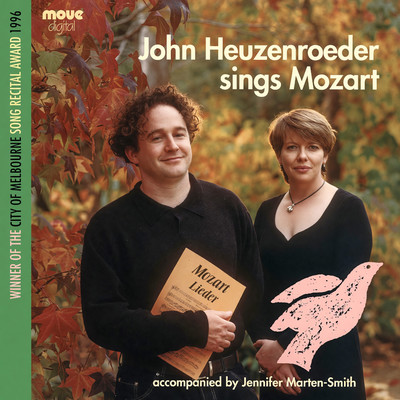
Judges of the City of Melbourne Song Recital Award praised Heuzenroeder’s unusual sense of style. Recorded at Move in April 1997, the disc captures a debut solo recital shaped for the intimacy of art song.
In the artist’s words
Apart from a few celebrated examples, Mozart’s twenty-nine songs for solo voice and piano are often overshadowed by developments in lieder that occurred during the nineteenth century, when the genre is generally acknowledged to have reached its zenith.
Beginning with the songs of Schubert, through the works of Schumann, Brahms, Wolf, Liszt and others, lieder was the ideal nexus through which poetry and music were combined to express the Romantic aesthetic. While some of Mozart’s later songs anticipate the great flowering of lieder which was to occur some twenty years later, his output belongs to the artistic climate of the late eighteenth century.
Like most other freelance composers of his time, Mozart was largely dependent on patronage for survival. Much of his time and talent was directed towards ‘public’ music making, such as the concerto, the symphony, and opera. Mozart was a pragmatic man, and he knew that providing these forms of music to the taste of both the aristocracy and the bourgeoisie was vital to his success and reputation in the important cities of Europe.
However, there was also a growing and important market for ‘private’ or parlour music, as wealthy middle classes began to organise regular musical entertainment in their own homes. The piano, undoubtedly the most popular instrument of the time, was the perfect instrument to accompany the voice. Demand for settings of popular melodies quickly increased, and as publishing houses became more widespread, the writing of lieder was taken up by many composers throughout Europe. In the many cities he visited, and particularly in Vienna later in his life, Mozart encountered many opportunities to provide chamber music and lieder, and most of his songs would have been produced quickly on request. In one instance, he wrote an unspecified song for a musical evening in between his dinner and attending the actual concert!
It seems that Mozart himself attached little importance to his songs; he does not make a direct mention of any of them in his extensive correspondence and he was less fastidious in his selection of poets than opera librettists. Despite this, his settings for each of the texts, particularly in the later songs, are rich in melodic invention and, as a group, they provide much listening pleasure. In nearly all his songs, virtuosity in both vocal line and piano part is avoided, a further indication of the appropriation of this form to the salon and amateur music making.
Mozart’s songs were written sporadically throughout his life and the majority are in strophic form. The earliest examples, An die Freude and Wie unglücklich bin ich nit, written during his teenage years, recall a baroque style, with the piano providing a simple continuo-like accompaniment. Mozart’s only songs in French, Oiseaux, si tous les ans and Dans un bois solitaire, written in 1777–1778, are more substantial. Their dramatic pauses and declamatory vocal writing show operatic influence, while the piano part embraces quasi-orchestral effects. Verdankt sei es dem Glanz, Sei du mein Trost, Ich würd’ auf meinem Pfad and Die Zufriedenheit all date from about 1780 when Mozart was in Salzburg. At only a dozen bars in length each, they display a simple hymn-like character.
Apart from Das Traumbild, which was written in Prague when Mozart was enjoying huge success with his opera Don Giovanni, the remainder of the songs were all composed in Vienna. Of these, the through-composed Das Veilchen is perhaps the best known on account of Goethe’s poetry and Mozart’s ability to characterise the subtle romantic overtones. The more elaborate Abendempfindung and An Chloe were written on the same day, and their vocal and pianistic sophistication, not to mention the sensual text of An Chloe, suggest they were probably conceived for a professional singer or very gifted amateur. The particularly beautiful and languorous Das Lied der Trennung is one of Mozart’s longest songs, and closely resembles Barbarina’s aria from act four of The Marriage of Figaro. Mozart’s last solo song, Das Kinderspiel, was written in the last year of his life. It seems a fitting conclusion to Mozart’s lieder output, embracing, as Mozart did throughout his life, the full joy of life and nature.
Reviews
... this recital ... reveals a voice of intoxicating sweetness used with skill ... commands attention among illustrious peers.
This disc is highly successful and eminently enjoyable to listen to ... This disc is a must for all music lovers.
The star of this CD is the singer himself. Heuzenroeder has a fine lyric tenor voice which makes these songs sound deceptively straightforward, navigating the higher end of the tenor range with no signs of strain. It is this masterly technique which allows him to put everything into the interpretation of the songs which come alive ... strongly recommended
Artists
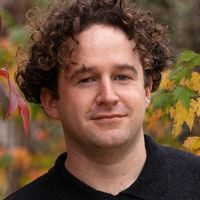
John Heuzenroeder
tenor
Announcing the winner of the 1996 City of Melbourne Song Recital Award, the judges described John Heuzenroeder's performance as one which struck them ‘as having a most unusual sense of style – a performance you know you will long remember.’
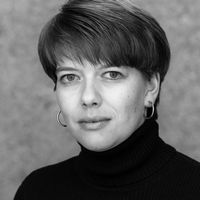
Jennifer Marten-Smith
piano
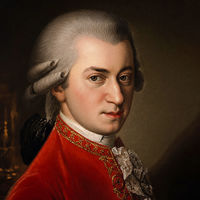
Wolfgang Amadeus Mozart
composer
Wolfgang Amadeus Mozart was a prolific and influential composer of the Classical era. He wrote over 600 works, many of them pinnacles of symphonic, concertante, chamber, piano, operatic and choral music, and remains among the most enduringly popular of classical composers.
Digital booklet
Digital booklet Notes, texts and credits — read online or download the PDF Download the PDFPerformers
- John Heuzenroeder · tenor
- Jennifer Marten-Smith · piano
Technical credits
-
Contributor
Alex Furman
Jeff Busby
Martin Wright
-
Recording Engineer
Martin Wright
Vaughan McAlley
-
Editing Engineer
Martin Wright
Vaughan McAlley
-
Mastering Engineer
Martin Wright
Vaughan McAlley
-
Venue
Move Records Studio
-
Thanks to
City of Melbourne
Denise Shepherd
Paul Bram Diamonds
Song Recital Award
The Robert Stolz Society
Details
- List price
- $25.00 AUD
- Total playing time
- 56 minutes 54 seconds
- Release date
- 1997
- Categories
- Classical, Vocal
- Genres
- Classical Era, Vocal & Opera
- Musical work copyright
- © 1997 Move Records
- Sound recording copyright
- ℗ 1997 Move Records
- Catalogue
- MD 3186
- EAN
- 9314574318623
More to explore
A Florentine Annunciation - The Music of the 14th Century Vol. 4
The Music of the Fourteenth Century series presents some of the earliest and most significant polyphonic settings of late-medieval lyric poetry. This volume offers music for the Feast of the Annunciation, performed by Les Six.
Hæc Dies
Easter at Notre Dame, Paris, c.1220. Music for Easter Sunday Mass as it may have been heard at Notre Dame early in the thirteenth century: chant propers, a complete ordinary cycle in two-part Leoninus-style settings, and three-part organum in the style of Perotin.
Encores
Directed by Douglas Lawrence, the Australian Chamber Choir gathers favoured concert encores in a programme that shows the ensemble at its most immediate and engaging.
Enfantines I
Katherine Day’s first solo album gathers piano works by Joachim, Krenek, Granados and Mozart chosen for young players. Her finely sculpted readings treat often-overlooked teaching repertoire with the care usually reserved for the concert canon.
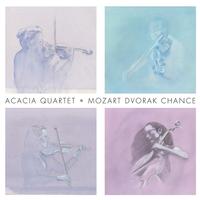
Acacia Quartet: Mozart Dvorak Chance
Three four-movement string quartets — Mozart’s D minor K. 421, Alice Chance’s Sundried, and Dvořák’s American — played with the clarity and ensemble blend Acacia Quartet is known for.
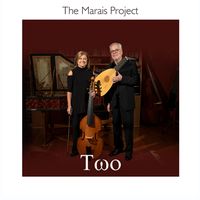
Two
Two brings together Marais Project founding members Jennifer Eriksson, viola da gamba, and Tommie Andersson, gallichon, theorbo and baroque guitar. Each plays alternate brackets of solos before they join in a splendid suite by Marin Marais.