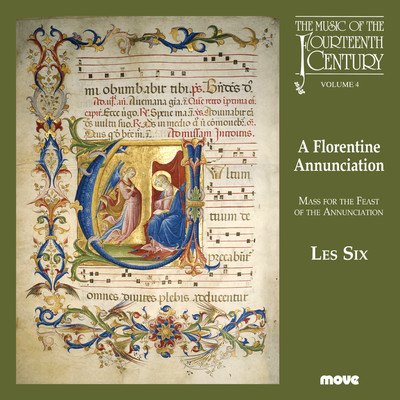
Listen & tracks
1 of 18 tracks have a preview · 17 works · 64:24
-
1 Amor dolçe sença pare 1:36
-
2 Introit 3:34
-
3 Kyrie 3:14
-
4 Gloria Gherardello da Firenze (Gherardello) 4:21
-
5 Alleluia 2:22
-
6 Ave maris stella [Organ] 1:36
-
7 Sequence 4:45
-
8 Sermon 9:00
-
9 Gloria [Organ solo] 6:12
-
10 Credo Bartholus de Florentia (Bartholus) 8:57
-
11 Offertory 2:13
-
12 Sanctus Lorenzo Masini (Lorenzo) 3:02
-
13 Motet Marchetto da Padova (Marchettus of Padua) 2:57
-
14 Agnus Dei Gherardello da Firenze (Gherardello) 1:46
-
15 Communion 1:12
-
16 Laudar vollio per amore 1:45
-
Benedicamus DominoDon Paolo 2 movements5:52
- 17 Benedicamus Domino [Organ] 2:28
- 18 Benedicamus Domino (Don Paolo) 3:24
Music of the 14th Century, Vol. 4.
A team of musicologists, literary scholars and performers from Melbourne University and La Trobe University and the Australian Research Council, under the direction of John Stinson and John Griffiths, collaborated to research and interpret works by principal composers and from the central collections of the fourteenth century. The musical sources of France and Italy in the age of Machaut, Petrarch and Boccaccio include some 1500 works, most of which have never been available on recordings.
In addition to the restoration, research and interpretation of important manuscripts, software developed for the project is used in over 30 universities around the world.
The Ensemble of the Fourteenth Century and Les Six are collectives of specialist singers and instrumentalists brought together for the Fourteenth Century Recording Project. Essentially formed around the leading mediaeval ensemble La Romanesca, the group was expanded to provide the varied instrumental and vocal combinations required by the repertory.
Mass for the Feast of the Annunciation – Patronal Feast of Santa Annunziata (Orbatello) via della Pergola, Firenze, 25 March 1417 (According to MSS Douai 1171 and Paris, BN it. 568)
Les Six
The Florentine year began on 25 March, as on that day the Christian world celebrates the Annunciation of the Virgin Mary, when it was revealed to her that she was to bear a son who would be the Redeemer.
This recording recreates the festive mass as it was performed in Florence in the early fifteenth century from a manuscript compiled by Don Paolo Tenorista, the most important composer of late-fourteenth-century Italy after Francesco Landini.
Accompanying notes provide details about the manuscript, analysis of each section of the mass, and translations. The programme includes a contemporary sermon by St Antoninus, Archbishop of Florence, delivered by Ivano Ercole.
In the artist’s words
The Music of the Fourteenth Century is produced by the Fourteenth Century Recording Project, a research project funded by the University of Melbourne, La Trobe University and the Australian Research Council. The project involves the collaboration of musicologists, literary scholars and performers under the direction of John Stinson and John Griffiths. The recordings resulting from this collaboration aim at being well-researched readings from original sources, interpreted according to current scholarship.
A Florentine Annunciation
The Florentine year began on 25 March, as on that day the Christian world celebrates the Annunciation to the Virgin Mary, when it was revealed to her that she was to bear a son who would be the Redeemer. It was also on that day in 1436 that the great dome which crowns both the Cathedral and the whole city was dedicated; and six months after this event, the last of the trecento composers who had made Florence known throughout Italy for its music, died. This recording gathers music for the feast of the Annunciation as it was performed in Florence in the early fifteenth century. The senior Florentine composer at the time was known by a number of titles: Don Paolo Tenorista, or Paolus Abbas (Paul the Abbot) and more formally as Don Paolo, Abbot of San Martino al Pino and rector of the church and hospice of Orbatello.
This recording recreates the festive mass from the chant manuscript which bears his name, set in its liturgical context in a polyphonic mass-cycle from the source which contains, in addition, almost all of his secular music. After Francesco Landini, he is the most important composer of late fourteenth-century Italy.
The mass cycle, comprising the Gloria by Gherardello, the Credo by Bartholus, Sanctus by Lorenzo Masini, Agnus Dei by Gherardello and Benedicamus Domino by Don Paolo is the only extant Italian cycle from the fourteenth century to have survived. The cycle recapitulates the musical styles current in Florence in the period 1350 to 1410, from what may be the earliest surviving piece of Florentine polyphony (the Credo) to the systematic exploration of the possibilities of the Italian rhythmic notation in the Benedicamus Domino.
The performances on this recording are all on a pipe organ with tracker action.
Artists

Les Six
ensemble
The vocal group Les Six were formed specifically to perform mediaeval and renaissance repertoire in authentic style.
Gherardello da Firenze
composer
Bartholus de Florentia
composer
Lorenzo Masini
composer
Marchetto da Padova
composer
Don Paolo
composer
Digital booklet
Digital booklet Notes, texts and credits — read online or download the PDF Download the PDFPerformers
- Les Six · ensemble
- Ivano Ercole · sermon · track 8
- John Stinson · director
- Hartley Newnham · countertenor, director
- Simon Biazeck · tenor
- John Heuzenroeder · tenor
- Tom Healey · tenor, organ
- Grantley McDonald · tenor
- Jerzy Kozlowski · bass
- Andrew Fysh · bass
Technical credits
-
Producer
Hartley Newnham
John Stinson
-
Recording Engineer
Martin Wright
-
Venue
Move Records Studio
-
Thanks to
Australian Research Council
La Trobe University
University of Melbourne
Details
- List price
- $25.00 AUD
- Total playing time
- 64 minutes 24 seconds
- Release date
- 1997
- Categories
- Early music, Vocal
- Genres
- Early Music, Choral & Sacred, Vocal & Opera
- Musical work copyright
- © 1997 The University of Melbourne, La Trobe University
- Sound recording copyright
- ℗ 1997 Move Records
- Catalogue
- MD 3094
- EAN
- 9314574309423
More to explore
Two Gentlemen of Verona - The Music of the 14th Century Vol. 1
Two Gentlemen of Verona gathers secular polyphony from the first known generation of Italian composers. This volume presents madrigals, caccie and a motet by Jacopo da Bologna and Giovanni da Firenze.
Every Delight and Fair Pleasure - The Music of the 14th Century Vol. 2
Northern Italian music from the second decade of the 14th century to the early 15th. Anonymous Rossi manuscript songs sit beside madrigals and ballatas by Maestro Piero and Bartolino da Padova.
I am Music - The Music of the 14th Century Vol. 3
The Music of the Fourteenth Century series presents some of the earliest and most significant polyphonic settings of late medieval lyric poetry. Songs by Francesco Landini, performed by the Ensemble of the Fourteenth Century.
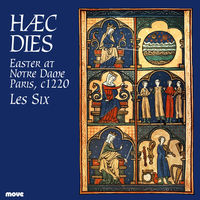
Hæc Dies
Easter at Notre Dame, Paris, c.1220. Music for Easter Sunday Mass as it may have been heard at Notre Dame early in the thirteenth century: chant propers, a complete ordinary cycle in two-part Leoninus-style settings, and three-part organum in the style of Perotin.

Becoming
Becoming is Johanna Selleck’s hour-long song cycle for soprano, countertenor, bass, shakuhachi and string quartet, setting haiku and renga across French, English and Tibetan.
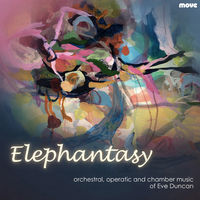
Elephantasy: Orchestral and Operatic Music of Eve Duncan
Orchestral, chamber and operatic works by Eve Duncan spanning 2012–2018: a piano concerto shaped by the Sydney Opera House, excerpts from her Malouf–James opera The Aspern Papers, and smaller chamber pieces for varied forces.