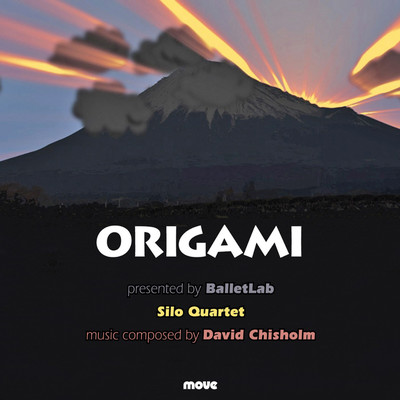
Listen & tracks
3 of 9 tracks have a preview · 9 works · 56:09
-
1 Wave Dance David Chisholm 4:08
-
2 Fold David Chisholm 8:02
-
3 Tent Dance David Chisholm 2:54
-
4 Falling Trees David Chisholm 5:35
-
5 How to Build a Set in 3 Minutes David Chisholm 2:57
-
6 Mountain David Chisholm 7:27
-
7 Pavane for a Pop-up Book David Chisholm 5:59
-
8 Ikebana David Chisholm 9:56
-
9 Origami David Chisholm 9:11
The ancient art of Japanese paper folding, origami, is the title for and inspiration behind this dance performance by artistic director, choreographer and founder of BalletLab, Phillip Adams. The music for this production was composed by David Chisholm, and performed by the Silo Quartet.
The work was performed at the Sydney Opera House in August 2006, and there were plans to stage it in San Francisco in 2008.
The CD also includes four short animations by Rhian Hinkley.
In the artist’s words
Origami explores the possible dialogue between dance, visual art, and choreographic design. The starting point for David Chisholm’s music for Origami is the European grouping of the string quartet. The structure of the music is built as if opening up one giant fold, like a reverse origami, flattening out the memory of the paper, not to erase it, but to create a place from whence it is possible to begin again.
The starting point for the music for origami is the European grouping of the string quartet, an icon as fascinating to the East as occidental perceptions of origami. The first half of the score is plunderphonic (a term coined by Canadian composer John Oswald) that uses several iconic modern quartets (including Schönberg’s 2nd and the Webern 6 Bagatelles) as the audio sources from which a reconstructed electronic virtual score is built.
At the halfway mark two violins, viola and cello are introduced with accompanying electronics. An extended climactic section – ikebana – is conceived as a “semi-virtual octet” section: live musicians playing to a pre-recorded complement of themselves. This live/virtual interplay preoccupies much of my work since 2003. origami concludes with a title track, written as a simulacrum obi-folding ritual. The idea of the quartet has emerged out of a virtual field and reasserts itself through live performance. The structure of the music is built as a series of interruptions along a giant fold line, like a reverse origami, flattening out the memory of the paper, of the quartet, not to erase it, but to create a place from whence it is possible to begin again.
Reviews
David Chisholm’s accompanying score ranges from luscious to dissonant, played mostly by a string quartet with a strong Japanese flavour.
Composer David Chisholm’s score is beautiful, grinding, intense and sometimes even more violent than the accompanying choreography.
the original music of composer David Chisholm played by a stringed quartet over synthesised sounds is quite riveting. The score’s often dissonant tone commands attention and enhances the pieces being performed.
Artists

Silo String Quartet
ensemble
Silo String Quartet was founded by cellist and composer Caerwen Martin in 1998. Their influences include Kronos String Quartet, Contemporary Australian, Asian and American repertoire.

David Chisholm
electronics, keyboards
David Chisholm is an Australian composer whose work spans orchestral, electro-acoustic, theatre, film and installation scores, alongside song cycles and dance commissions.
Digital booklet
Digital booklet Notes, texts and credits — read online or download the PDF Download the PDFPerformers
- Silo String Quartet · ensemble · tracks 6–9
- David Chisholm · electronics, keyboards · tracks 1–5
- Aaron Barnden · violin · tracks 6–9
- Andrea Keeble · violin · tracks 6–9
- Ceridwen Davies · viola · tracks 6–9
- Caerwen Martin · cello · tracks 6–9
Technical credits
-
Contributor
Rhian Hinkley
-
Venue
Move Records Studio (tracks 6–9)
-
Credit
Jeff Busby
Martin Wright
Details
- List price
- $25.00 AUD
- Total playing time
- 56 minutes 9 seconds
- Release date
- 2006
- Categories
- Australian, Classical
- Musical work copyright
- © 2006 Move Records
- Sound recording copyright
- ℗ 2006 Move Records
- Catalogue
- MD 3307
- EAN
- 9314574330724
More to explore
Butterfly Modernism
Composer Eve Duncan’s third release is a two-CD set of chamber works that marks a clear shift in her musical language.

Becoming
Becoming is Johanna Selleck’s hour-long song cycle for soprano, countertenor, bass, shakuhachi and string quartet, setting haiku and renga across French, English and Tibetan.

Sunburnt Aftertones
Katy Abbott’s chamber music, spanning her career to date, shows her gift for drawing listeners straight into an evocative sound world. Place, travel and instrumental colour shape these direct, pictorial scores.