Listen & tracks
5 works · 40:42
-
1 Free Music 1 and 2 Percy Grainger (Sketches for an electronic piece) 1:55
-
2 Tracks from Divertimento Tristram Cary 4:16
-
3 Study for Symphony: August 9th Warren Burt 15:55
-
4 Through Clouds Barry Conyngham 10:53
-
5 I Am Not a Computer Darius Clynes 7:43
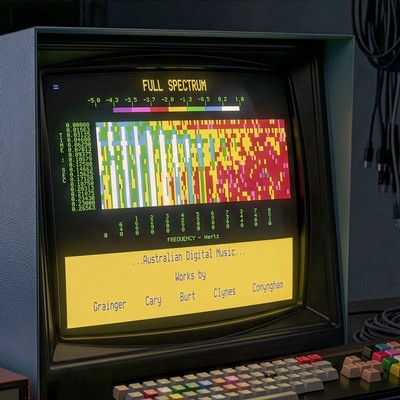
The programme maps the range of sound then generated or controlled by digital devices. It opens with Percy Grainger's Free Music 1 and 2, sketched around 1935: freely gliding tones beyond ordinary human performance, finally realised here by Barry Conyngham from the graphic score on the Music V system at the University of Melbourne.
Alongside it stand Tristram Cary's machine-derived Tracks from Divertimento, Warren Burt's Study for Symphony: August 9th (built on his Aardvarks IV control system), Conyngham's own direct-synthesis Through Clouds, and Darius Clynes's I Am Not a Computer. Full notes and photographs are on the downloadable PDF.
In the artist’s words
At about the age of 25, the famous Australian-born pianist and composer Percy Grainger became convinced his visionary music of the future, Free Music, was beyond the ability of human performers. Much of his work until his death in 1961 was devoted to the invention of a machine capable of playing his Free Music. Sadly for Grainger his ideas were years ahead of the technological means of realising them.
What Grainger was looking for was an instrument which could play precisely notated gliding pitches, at variable amplitudes, with absolute rhythmic precision, for any number of simultaneous, independent voices. Free Music Nos. 1 and 2, the only surviving sketches in Free Music style, were written about the time of his Australian tour of 1934–35. They are made on graph paper with the top half of the vertical axis marked out with pitch levels and the bottom half with loudness levels. The horizontal axis represents time measured in metronome beats. Each voice is then represented as a line on the pitch graph with a corresponding line on the amplitude graph.
Whether or not Percy Grainger's Free Music is worthy of a place in the history of twentieth-century music is yet to be decided. Whatever the outcome, Grainger's ideas deserved a better fate than to have had to wait so many years after their conception to be realised.
(The Free Music materials are on display at the Grainger Museum, University of Melbourne.)
Some forty-three years after he conceived them it is now possible to realise Grainger's concept of freely gliding tones taken direct from a graphic score. The realisation of this recording was made on the Music V system running at the Computer Music Project at the University of Melbourne. The graphs, taken from reproductions of the score in the composer's own hand, were put into the machine as functions. Certain translation had to be done as the original data is not in hertz or decibels, but in Grainger's own adaptation of traditional musical terms. For instance, the octave is divided into 24 divisions, the amplitude into 70 divisions. Also, to attain the accuracy of the data in each voice (four in Free Music I, six in Free Music II) each one was synthesised separately, then mixed digitally before outputting the final result through a digital-to-analogue converter.
No attempt has been made to add colour to the sound; it is pure sine wave, as Grainger would have wished. There seems no other way to obtain the desired accuracy other than by a computer synthesis technique.
Artists
Barry Conyngham
performer
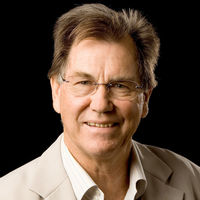
Barry Conyngham, born in Sydney, has received numerous awards and fellowships for composition, among them Churchill, Harkness, Australia Council and Senior Fulbright grants. He holds an ARIA, two Sounds Australian Critics Awards and two Maggs Awards.

Tristram Cary
performer
Tristram Cary's electroacoustic music spans half a century of tape and computer invention, from dense analogue microcosms built for radio and film to sharp, playful late works for digital machines.
Warren Burt
performer
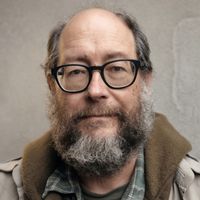
Warren Burt has worked in academia, education and radio, and as a composer, filmmaker, video artist, writer and community-arts organiser. He has produced a large body of work for instruments, electronics, voice, video, theatre, prose and poetry, performed and shown in the USA, Australia, Europe and Japan.
Darius Clynes
performer
Darius Clynes is a composer of early computer and electronic music. His 1976 work I Am Not a Computer belongs to that experimental repertoire.
Percy Grainger
composer
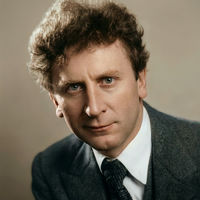
Percy Aldridge Grainger (1882–1961) was an Australian-born composer, arranger and pianist. A brilliant folk-song collector and arranger, he was also a restless experimenter whose work ranged from tuneful percussion to Free Music machines that foreshadowed electronic synthesis.
Digital booklet
Digital booklet Notes, texts and credits — read online or download the PDF Download the PDFPerformers
- Barry Conyngham · tracks 1 and 4
- Tristram Cary · track 2
- Warren Burt · track 3
- Darius Clynes · track 5
Technical credits
-
Contributor
Gerard Lier
Jan Dalman
Martin Wright
Roberto Laneri
-
Producer
Barry Conyngham
-
Venue
Computer Music Project, University of Melbourne
Latrobe Studios
University of Adelaide Recording Studios
University of Melbourne Electronic Music Studio
Details
- List price
- $20.00 AUD
- Total playing time
- 40 minutes 42 seconds
- Release date
- 1978
- Categories
- Australian, Classical
- Musical work copyright
- © 1978 Move Records
- Sound recording copyright
- ℗ 1978 Move Records
- Catalogue
- MD 3027
- EAN
- 9314574302721
More to explore
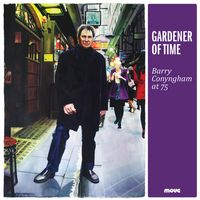
Gardener of Time: Barry Conyngham at 75
This double-CD gathers seven orchestral works by Barry Conyngham, among Australia’s most widely performed composers abroad, with premieres across Japan, America, Europe, Russia and Australia. The Ormond Ensemble is conducted by Richard Davis.
Move 50
Twenty-four Australian composers mark Move Records’ fiftieth year with short new works gathered on this commemorative disc.
Flute Perspectives, Vol. 1
Flautist Derek Jones and pianist Leigh Harrold present this anthology of contemporary Australian flute music, from Sculthorpe’s Torres Strait cycle to solo and duo works by leading local composers.
Astra 60
This recording captures a concert of Australian piano music celebrating Astra’s long support of Australian composers and performers. For sixty years the Astra Chamber Music Society has placed new Australian work beside international new-music currents, always with a distinctive cultural frame.
Music for Strings
String orchestra music from Wolf-Ferrari and Grieg to Britten, Grainger and living Australian voices. Gerald Gentry leads the Southern Cross Philharmonia, with Amir Farid at the piano in Grainger’s clog-dance romp.

Burns and Beyond
This recording, Burns and Beyond, gathers art songs for voice and modern piano drawn from Robert Burns, and includes Percy Grainger’s Three Scotch Folksongs, built on ancient Scottish tunes.