
Listen & tracks
1 of 19 tracks have a preview · 18 works · 61:49
-
1 Ex semine Abrahe / Ex semine Rosa / [Ex semine] Pérotin 3:08
-
2 O Virgo splendens Anonymous 4:42
-
3 Alma Redemptoris Mater Gregorian Chant 1:37
-
4 Ave Regina caelorum Gregorian Chant 1:44
-
5 Regina caeli Gregorian Chant 1:41
-
6 Salve Regina Gregorian Chant 2:50
-
7 Ave maris stella John Dunstable 3:29
-
8 Alma Redemptoris Mater Johannes Ockeghem 4:48
-
9 O Maria, vernans rosa Clemens non Papa 8:22
-
Ave MariaGregorian Chant 2 movements5:23
- 10 Ave Maria 1:12
- 11 Ave Maria 4:11
-
12 Salve Regina Tomás Luis de Victoria 4:16
-
13 Ave Virgo gloriosa Richard Dering 2:42
-
14 Magnificat Hieronymus Praetorius 6:45
-
15 Alma Redemptoris Mater Jan Dismas Zelenka 2:03
-
16 Ave Regina caelorum (i) Jan Dismas Zelenka 2:05
-
17 Ave Regina caelorum (ii) Jan Dismas Zelenka 1:57
-
18 Regina caeli Jan Dismas Zelenka 2:29
-
19 Salve Regina Jan Dismas Zelenka 1:48
The red rose is one of the most enduring images of the Virgin Mary. It carries wide-ranging associations: the fertility of the Madonna, the beauty of the bride of Christ, the fragrances of Heaven, the passion and romance of the Troubadour, the poignancy of the crown of thorns and the rich colour of spilt blood. Like the rose, the music that depicts or venerates Mary is varied.
Under leading Australian Early Music interpreter Gary Ekkel, Schola Cantorum of Melbourne traces that imagery through chant, song and motet. The programme moves from Pérotin and the Llibre Vermell, through Renaissance settings by Ockeghem, Clemens non Papa, Guerrero, Victoria and Dering, to Praetorius’s Magnificat and five Marian antiphons by Jan Dismas Zelenka.
Reviews
…The high point of the music-making here is the spirited performance of five Marian antiphons by Jan Dismas Zelenka, a Bohemian composer working in baroque Dresden.
For quiet meditation, pure moving music portraying the life of the Virgin Mary is beautifully captured by Schola Cantorum
nicely programmed ... an enjoyably 'real' performance and a most pleasant disc.
Artists
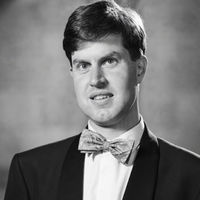
Gary Ekkel
conductor
Gary Ekkel is a leading Australian interpreter of choral and Early Music.
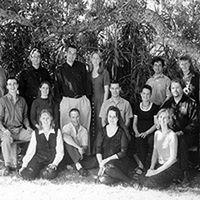
Schola Cantorum of Melbourne
choir
Schola Cantorum of Melbourne has established a reputation for presenting sacred music from the Middle Ages, Renaissance and Baroque together with Gregorian chant in historical and innovative contexts.
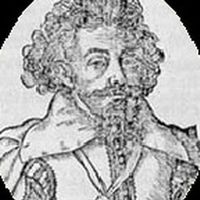
Hieronymus Praetorius
composer
Hieronymus Praetorius composed a Magnificat included in a sacred programme honouring the Virgin Mary.
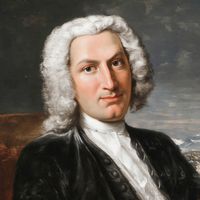
Jan Dismas Zelenka
composer
Jan Dismas Zelenka wrote Baroque sacred music of striking harmonic inventiveness and contrapuntal mastery: masses, litanies, psalms and Marian antiphons whose passion still startles in performance.

Richard Dering
composer
John Dunstable
composer
John Dunstable's surviving music is sacred and vocal: isorhythmic motets, mass movements and Marian antiphons built on full triadic harmony, with a liking for thirds and sixths that marked the English manner of the early fifteenth century.
Francisco Guerrero
composer
Francisco Guerrero (1528–1599) was a Spanish Renaissance composer and Catholic priest, admired for sacred motets and masses as well as secular songs that long outlived him in cathedral and court repertory.
Johannes Ockeghem
composer
Johannes Ockeghem wrote masses, motets and chansons at the centre of early Renaissance polyphony. Surviving works include canonic and freely composed masses and Marian motets whose independent voices and wide-ranging bass lines shape the Franco-Flemish sound.
Clemens non Papa
composer
Clemens non Papa’s motets are high Renaissance polyphony at full stretch: Marian devotion in O Maria, vernans rosa, Christmas wonder in the six-voice O magnum mysterium, and the stark grief of Vox in Rama.
Pérotin
composer
Tomás Luis de Victoria
composer
Tomás Luis de Victoria wrote almost exclusively sacred polyphonic music to Latin texts: motets, Marian antiphons and Holy Week offices whose intensity and direct emotional line set him among the principal voices of the late Renaissance.
Digital booklet
Digital booklet Notes, texts and credits — read online or download the PDF Download the PDFPerformers
- Schola Cantorum of Melbourne · choir
- Gary Ekkel · conductor
- Ross Mitchell · violin · tracks 15 and 19
- Fiona Furphy · cello · tracks 15–19
- Elizabeth Anderson · chamber organ · tracks 15–19
Technical credits
-
Recording Engineer
Martin Wright
-
Editing Engineer
Vaughan McAlley
-
Venue
Xavier College Chapel
Details
- List price
- $25.00 AUD
- Total playing time
- 61 minutes 49 seconds
- Release date
- 1998
- Categories
- Choral, Early music
- Genres
- Early Music, Choral & Sacred
- Musical work copyright
- © 1998 Move Records
- Sound recording copyright
- ℗ 1998 Move Records
- Catalogue
- MD 3209
- EAN
- 9314574320923
More to explore
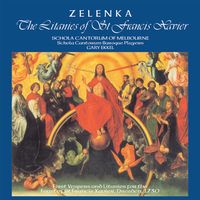
The Litanies of St. Francis Xavier
A generous 2-CD set of Jan Dismas Zelenka’s liturgical music from the Schola Cantorum of Melbourne: the Litaniae Xaverianae, five Vespers psalms, the Magnificat in D and the Alma Redemptoris Mater.
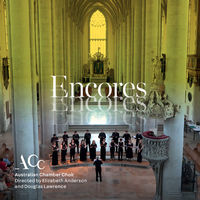
Encores
Directed by Douglas Lawrence, the Australian Chamber Choir gathers favoured concert encores in a programme that shows the ensemble at its most immediate and engaging.
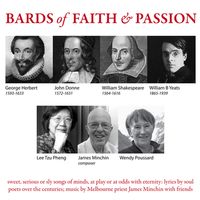
Bards of Faith and Passion
Jim Minchin sets poems by writers at play or at odds with eternity: soul-poet lyrics across the centuries, from anonymous Latin verse and the metaphysicals to Yeats, Shakespeare and living voices.
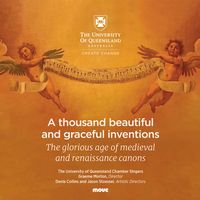
A Thousand Beautiful and Graceful Inventions
Subtitled ‘The glorious age of medieval and renaissance canons’, this programme of late Middle Ages and Early Modern choral music is sung by the University of Queensland Chamber Singers under Graeme Morton. The illustrated booklet has programme notes by Denis Collins and Jason Stoessel, with complete texts.
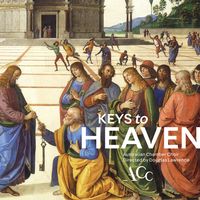
Keys to Heaven
The Australian Chamber Choir opens with the first recording of Agata della Pietà’s cantata Ecce nunc, written in eighteenth-century Venice by an orphan of the Ospedale della Pietà and reconstructed by Elizabeth Anderson. Sacred works by Palestrina and Allegri complete the programme.
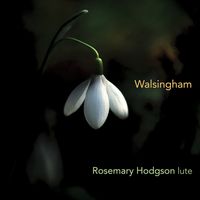
Walsingham
Renowned Australian lutenist Rosemary Hodgson’s Walsingham gathers Elizabethan lute variations on a sacred ballad into a contemplative Marian rondo of mysticism and pilgrimage.